Summary: When their brains are stimulated with leptin, an appetite-suppressing hormone, hungry mice prioritize mating and interacting with mice of the opposite gender over eating.
Source: Cell Press
To eat or to mate—that is the question (and the answer is: moderately hungry mice choose to mate).
Researchers publishing in the journal Cell Metabolism on Thursday February 23 show that hungry mice prioritize interacting with members of the opposite sex over eating and drinking when their brains are stimulated with leptin, an appetite-suppressing hormone.
“We can only pursue one behavior at a time, so our brain has to somehow compute what will be the most rewarding behavior, or what is our most urgent need,” says senior author Tatiana Korotkova, a neuroscientist at the University Clinic Cologne in Germany.
To elucidate the hierarchy of innate behaviors like eating, drinking, socializing, and mating, Korotkova’s team observed and stimulated mouse neurons within the lateral hypothalamus, one of the main “feeding centers” of the brain.
They focused on neurons that bear receptors for leptin and neurons that produce neurotensin, two hormones with ties to hunger and thirst.
To their surprise, they found that these neurons were also involved in guiding social behavior and helping the mice balance their nutritional and social needs.
“We were astonished to find that the lateral hypothalamus links feeding and drinking to social behaviors,” says first author Anne Petzold, also a neuroscientist at the University of Cologne. “Activating leptin receptor neurons makes mice prioritize social interaction despite acute hunger or thirst. This makes sense biologically because mating partners are not something that you have around all the time, and so one must be able to ignore hunger or thirst to be able to engage in mating.”
The researchers used tiny microscopes to visualize the activity of individual brain neurons while the mice explored and engaged in various behaviors in an enclosure. “It was a huge advantage that we could record the activity of neurons in a freely behaving animal,” says Korotkova. “We could really see how neuronal activity changes during particular behaviors, and we could track and change the activity of individual cells with a high time precision.”
To see how the mice’s priorities changed according to their hunger level, the team compared the behavior of mice who had unlimited access to food to “acutely hungry” mice (whose food had been restricted overnight) and “chronically hungry” mice (whose food had been restricted for 5 days). The researchers note that this “chronic hunger” can also occur in the wild, where food is not available all the time.
They found that leptin receptor neurons were inhibited when the mice ate and were activated when they interacted with mice of the opposite sex—potential mates—but not when they interacted with mice of the same sex.
Next, the researchers used light and chemical signals to selectively stimulate neurons, which allowed them to observe whether and how this activation altered the mice’s behavior.
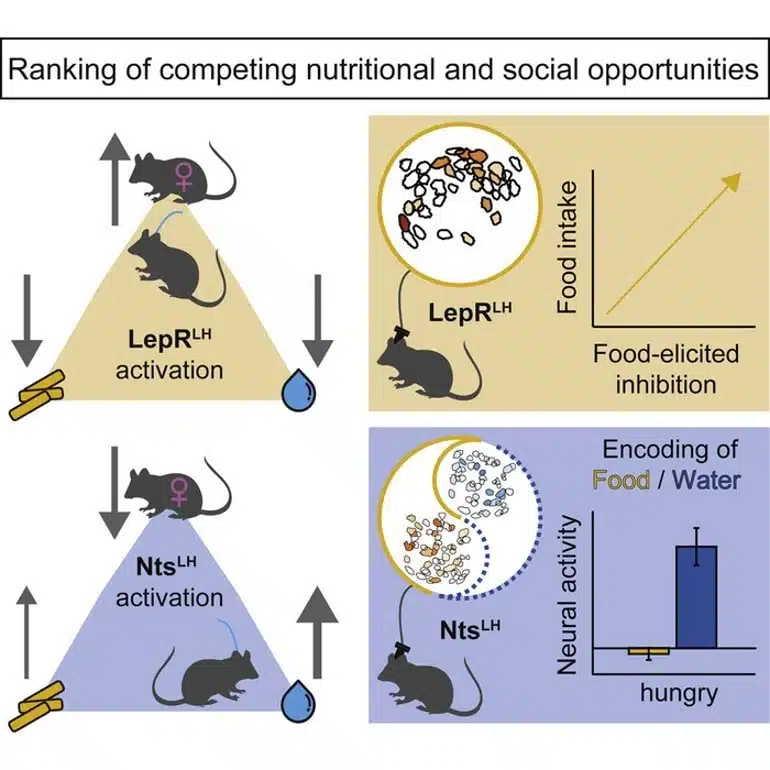
Leptin stimulation had little effect on the behavior of sated mice, who were generally more interested in socializing than eating, but when the researchers activated the leptin receptor neurons of acutely hungry mice, their priorities changed: they were slower to approach food, ate less, and spent more time socializing with potential mates.
However, leptin stimulation was not able to override the stronger hunger of chronically food restricted mice, whose appetites were unreduced and priorities unmoved by leptin activation.
“So, we have this system which can only regulate moderate hunger, but not strong hunger,” says Korotkova. “This circuit might contribute to why diets don’t work: it’s not a problem to reduce your food intake for a short time, but it doesn’t work if you try to do it for longer.”
In contrast, when the researchers activated neurotensin neurons, they observed increased drinking behavior at the expense of socializing, both with potential mates and with mice of the same sex.
“We usually think about neurons having a particular function, but we found that one cell can actually encode multiple different stimuli,” says Korotkova. This makes a lot of sense biologically because behaviors need to be coordinated, and it’s much more efficient to coordinate behaviors with the same cell than by many different cell types somehow communicating with each other.”
“Next, we’d like to understand how the activity of these cells changes during the progression of obesity or the development of eating disorders,” says Korotkova.
Funding: This research was supported by the ERC Consolidator Grant and the German Research Foundation.
About this behavioral neuroscience research news
Author: Liana Wait
Source: Cell Press
Contact: Liana Wait – Cell Press
Image: The image is credited to Petzold et al
Original Research: Open access.
“Complementary lateral hypothalamic populations resist hunger pressure to balance nutritional and social needs” by Petzold et al. Cell Metabolism
Abstract
Complementary lateral hypothalamic populations resist hunger pressure to balance nutritional and social needs
Animals continuously weigh hunger and thirst against competing needs, such as social contact and mating, according to state and opportunity. Yet neuronal mechanisms of sensing and ranking nutritional needs remain poorly understood.
Here, combining calcium imaging in freely behaving mice, optogenetics, and chemogenetics, we show that two neuronal populations of the lateral hypothalamus (LH) guide increasingly hungry animals through behavioral choices between nutritional and social rewards.
While increased food consumption was marked by increasing inhibition of a leptin receptor-expressing (LepRLH) subpopulation at a fast timescale, LepRLH neurons limited feeding or drinking and promoted social interaction despite hunger or thirst.
Conversely, neurotensin-expressing LH neurons preferentially encoded water despite hunger pressure and promoted water seeking, while relegating social needs.
Thus, hunger and thirst gate both LH populations in a complementary manner to enable the flexible fulfillment of multiple essential needs.