
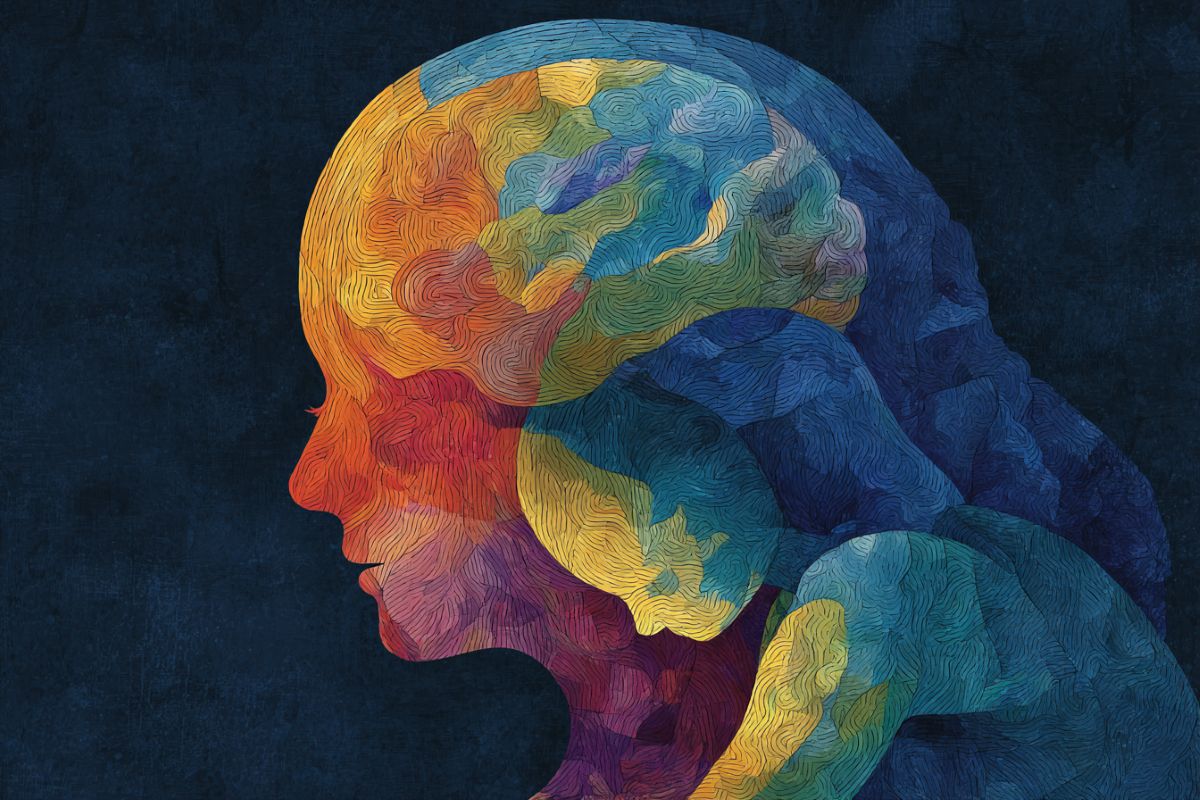
Summary: What makes us human? For decades, scientists have debated whether our ability to speak and our ability to understand others’ feelings (Theory of Mind) grew from the same “mental soil.” A new study has finally settled the question.
Using fMRI to scan children as young as three, researchers found that these two sophisticated skills originate from completely separate, non-overlapping brain regions. This “discrete architecture” suggests that our brains evolved with specialized wiring for language and empathy from the very beginning, rather than these skills branching off from a single cognitive source as we grow.
Key Facts
- Hemispheric Separation: The research identified the superior temporal lobe as the hub for both skills, but with a strict geographical divide: Language is based in the left hemisphere, while Theory of Mind is based in the right.
- No Developmental Overlap: Contrary to prior theories that children’s brains are “messier” and become specialized later, the study showed that even in 3-year-olds, these regions are already distinct and do not overlap.
- The Connectivity Fingerprint: By analyzing “resting-state” scans, researchers identified unique communication patterns for each region. These “fingerprints” prove that the two systems talk to the rest of the brain in entirely different ways.
- Stable Wiring: Longitudinal data (tracking the same children over time) showed that this neural separation is stable throughout childhood. It doesn’t “unfold” as we age, it is part of the brain’s baseline blueprint.
- Adult Integration: Interestingly, while the regions are separate in kids, the networks start to “talk” to each other more in adults, suggesting we learn to use these complementary skills in tandem as we mature.
Source: Ohio State University
A new study is the first to show that two of our most sophisticated cognitive functions, using and understanding language and being able to sense how other people feel, have distinct origins in the brain in young children – matching what we know about the adult brain.
The findings suggest that these separate but related ways of processing complex concepts, both uniquely human skills, do not originate from overlapping brain areas and grow more distinct as the mind matures, which challenges prior theories. Instead, our brains appear to have evolved with discrete architecture and wiring enabling these different kinds of thinking.
Using fMRI to scan the brains of children while they listened to spoken language and watched a short movie, the researchers found that parts of the brain responsible for language and mentalizing, known as theory of mind, are separate and do not overlap. Additional analysis of how these regions communicate with other brain areas at rest reinforced the imaging data.
“It seems that these processors that help us mentalize and that help us speak and understand were dissociated very, very early in the evolutionary process, such that we can’t even see traces of overlap right now in human development,” said Zeynep Saygin, senior author of the study and an associate professor of psychology at The Ohio State University.
“It’s a fundamental question humans ask themselves: ‘What is it that makes us human? How does human cognition emerge?’ I think this sheds some light on that.”
Kelly Hiersche, a doctoral student in Saygin’s lab, led the study, published April 23 in Communications Biology. David Osher, assistant professor of psychology, was also a co-author and collaborator.
The two communication skills of focus originate from a region of the brain called the superior temporal lobe, located near each temple – with language based in the left hemisphere and theory of mind based in the right.
The researchers first confirmed with fMRI scans of the brain in 28 adults what has been found before – that separate and distinct regions associated with language and theory of mind did, indeed, respond strongly to stimuli intended to activate those areas.
The team then worked with 42 children between ages 3 and 9, scanning their brains with 2 fMRI scans, one while they listened to sentences and another while they watched a silent cartoon, observing which brain regions were activated for each task. Control conditions included nonsense words for the language assessment and, for the mentalization evaluation, signs of pain in cartoon characters – which elicits a pain response rather than theory of mind.
Results of the scans and additional analysis – imaging at the 2-3 millimeter, or 3D voxel, level of the brain across both hemispheres – showed that the regions responding to language stimuli and theory of mind stimuli were separate, with no overlap.
“That was our first question: Are these skills distinct in both their function and location? And we see really broadly, yes,” Hiersche said. “We demonstrate this for the first time in kids, extending an adult finding to development. They’re really distinct there, which is pretty cool.”
To tap further into the evolutionary question, the researchers took fMRI scans of the adults’ and children’s brains at rest – when the brain is still busy, but not being asked to respond to specific stimuli – to observe what other brain regions these separate language and mentalization regions were connecting with.
“If you observe a voxel’s connectivity, or how it talks to the rest of the brain, that’s going to give you an idea about how that voxel is going to function,” Hiersche said. This is the idea of a connectivity fingerprint: a unique connectivity pattern that determines the unique function of a brain region.
Using predictive modeling to characterize these connectivity fingerprints, the researchers found that there was more to the language and theory of mind distinctions than their locations on separate sides of the brain.
“Regions of the brain that are functionally specific should be communicating in a unique way,” Saygin said. “We knew these regions were localized in different parts of the brain, but also showed that there’s nothing in how they communicate with the rest of the brain that indicates that they were at any point overlapping.”
Looking for changes in the kids’ connectivity fingerprints over time further drove home the point that the regional and functional distinctions don’t change during childhood brain development.
“We were able to not just look across different kids, but look within the same child to see what happened over time,” Hiersche said. “And we showed that it’s not the case that when you’re 3 years old, you see a lot of overlap in these functions, but then when you get to 5 years old, they pull apart and become more separate.
“The connections we’re seeing that support these tasks – and that also separate them – are stable within the same person over time.”
In fact, comparing the differences in connectivity fingerprints between children and adults showed that while these functions and connectivity patterns are quite clearly separate and distinct in kids, there is some overlap across brain networks in adults – a sign of change in how we make use of the complementary skills.
“In adults, the mentalizing theory of mind network starts to talk to slightly similar regions as the language areas. In children, as those skills keep developing, maybe those networks are talking to each other more,” Saygin said.
These results challenge the idea that language and mentalizing have similar origins and instead support distinct mechanisms for these communicative skills, she said.
Funding: This work was supported by the U.S. National Science Foundation, the Alfred P. Sloan Foundation, the National Institutes of Health, and Ohio State’s College of Arts and Sciences, Center for Brain Injury Recovery and Discovery, and Women in Philanthropy award.
Key Questions Answered:
A: Not according to this research. Because the brain architecture for language and Theory of Mind (empathy/mentalizing) is discrete, a delay in one does not automatically imply a delay in the other. They are running on two different “hard drives.”
A: Researchers show movies where characters have “false beliefs” (e.g., a character looks for a toy in a box not knowing it was moved). To understand why the character is confused, the brain must “mentalize”, or step into the character’s perspective.
A: As we get older, our social interactions become more complex. We don’t just speak; we speak with the intent to influence or comfort others. The increased communication between these networks in adults likely reflects our ability to use language and empathy simultaneously to navigate life.
Editorial Notes:
- This article was edited by a Neuroscience News editor.
- Journal paper reviewed in full.
- Additional context added by our staff.
About this theory of mind and neurodevelopment research news
Author: Emily Caldwell
Source: Ohio State University
Contact: Emily Caldwell – Ohio State University
Image: The image is credited to Neuroscience News
Original Research: Open access.
“Functional dissociation of language and theory of mind in the developing superior temporal lobe” by Kelly J. Hiersche, David E. Osher & Zeynep M. Saygin. Communications Biology
DOI:10.1038/s42003-026-10040-2
Abstract
Functional dissociation of language and theory of mind in the developing superior temporal lobe
Language and theory of mind (ToM; the ability to infer others’ mental states) are both crucial for human communication, and yet their developmental origins are unclear.
Are their neural substrates distinct within the superior temporal lobe (STL) but with opposing lateralization, as in adults? Or do they emerge from common neural substrates during development, perhaps in homologous regions originally involved in more basic social processing?
Here we investigate the development of this functional dissociation, and the dissociation of their underlying connectivity fingerprints in a large cohort of children (ages 3-9 years, n = 54 sessions, n = 42 subjects) and adults (n = 28).
We demonstrate that children show distinct patterns of neural specificity for language and ToM in STL, just like adults. Children show no evidence of developmental ‘disentangling’ cross-sectionally or longitudinally.
Finally, children’s connectivity fingerprints predicting future language or ToM activation are almost identical to concurrent fingerprints and are largely non-overlapping across domains. While linguistic and ToM processing undergo continued neural specialization to reach the mature adult-like state, they are remarkably distinct early in human development.
Our results challenge the idea that language develops from neural processors common for social communication and instead support distinct neural origins of these mental domains.