

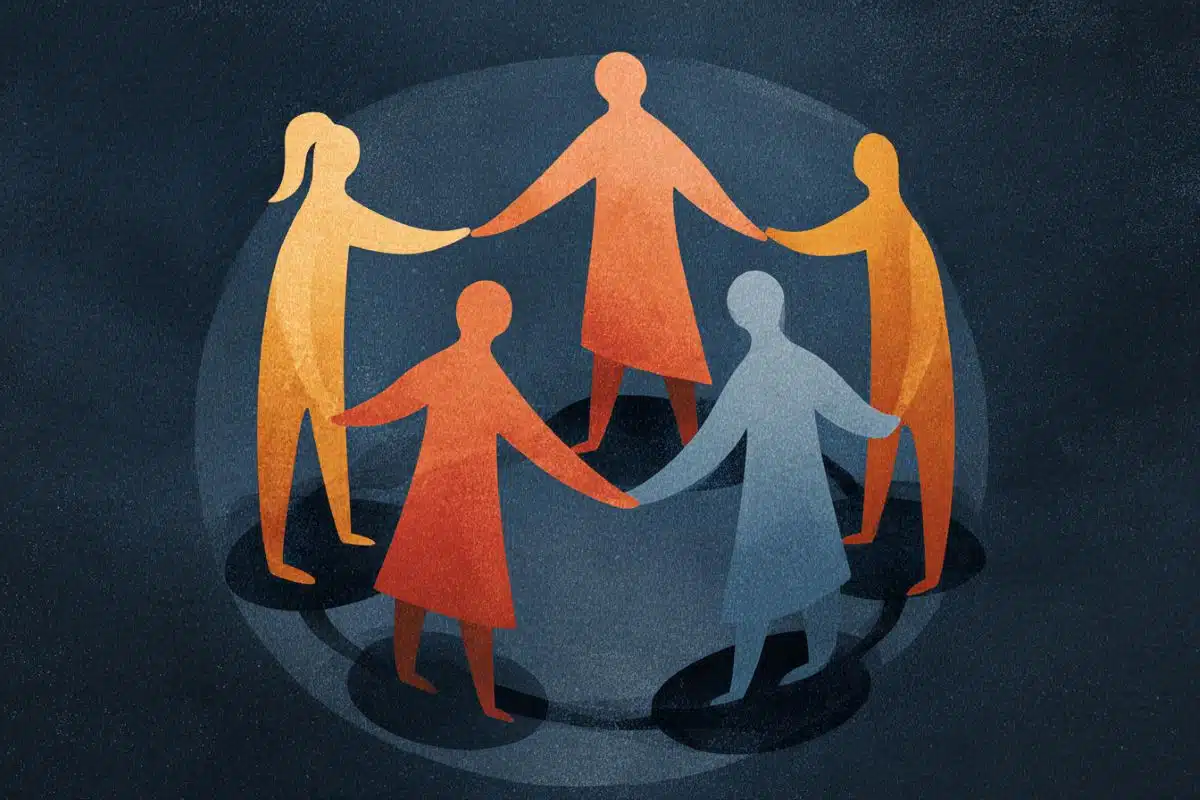
Summary: When two people click, their bodies often start to move in rhythm—literally. A new comprehensive review explores interpersonal physiological synchrony, the phenomenon where heart rates, skin conductance, and even neural patterns align between individuals during social interaction.
Researchers argue that this isn’t just a byproduct of shared activity, but a dynamic, multi-layered “biological attunement” that shifts depending on context—whether we are cooperating, competing, or creating. The review calls for a shift from simply asking if we synchronize to uncovering when and why this biological alignment serves as the foundation for empathy and human connection.
Key Facts
- The Indicators: Physiological synchrony is measured through aligned heart rate, heart-rate variability (HRV), and electrodermal activity (sweat gland response) between people.
- Context Matters: Synchrony is not a “static” state; it evolves during an interaction. It can peak during moments of intense collaboration and drop or shift during competition or stress.
- Beyond the Duo: Future research is expanding into “group synchrony” to understand how biological alignment fuels teamwork, crowd behavior, and the formation of social coalitions.
- Empathy Connection: The alignment of physiological signals is believed to be a primary biological mechanism behind empathy and mutual understanding.
- Multi-Modal Research: The authors advocate for new studies that combine physiological data with brain imaging and behavioral tracking to create a “full map” of human connection.
Source: Bar-Ilan University
How people connect with one another may be more complex — and more fascinating — than previously thought.
A new review in Nature Reviews Psychology explores the emerging science of interpersonal physiological synchrony, the phenomenon in which people’s bodies appear to “move together” during social interaction.
Interpersonal physiological synchrony refers to the alignment of signals such as heart rate, heart-rate variability, and electrodermal activity between individuals. While the idea that people can become biologically attuned to one another is compelling, research findings have been surprisingly mixed, with many studies reporting conflicting or null results.
The review suggests that synchrony is not a single, uniform process but a dynamic, multi-layered phenomenon shaped by context, individual differences, and the nature of social interaction. Rather than asking simply whether synchrony exists, the authors urge researchers to explore when, how, and under what conditions it emerges — and what it actually means for human behavior.
In the review invited authors Prof. Ilanit Gordon, from the Department of Psychology at Bar-Ilan University, and Prof. Ronny Bartsch, from the Department of Physics at Bar-Ilan University, highlight the need to move beyond static measurements toward studying synchrony as it unfolds over time. Social interactions are not fixed events but evolving exchanges, and physiological alignment may shift across moments of stress, cooperation, competition, or shared creativity.
The study also points to exciting new frontiers for the field. Future research may examine synchrony in larger groups, opening the door to understanding how biological alignment influences socialization, teamwork, and even complex social processes such as coalition formation or collective behavior.
In addition, the review calls for more rigorous and innovative experimental designs, including replication studies, multimodal approaches that combine physiological, behavioral, and neural data, and emerging causal methods such as biofeedback-based interventions.
As the field advances, researchers hope to uncover not only whether our bodies synchronize during social interaction, but what that synchronization reveals about empathy, collaboration, mental health, and human connection itself.
Key Questions Answered:
A: Science says yes, but it’s not exclusive to romance! It happens between parents and children, close friends, and even effective teammates. When you are deeply engaged with someone, your autonomic nervous systems begin to mirror each other, creating a shared biological rhythm.
A: You can certainly encourage it. Shared activities like rhythmic breathing, singing in a choir, or even walking in step can “prime” the body for physiological alignment, which often leads to increased feelings of trust and cooperation.
A: A lack of synchrony can be a sign of social “friction” or a lack of rapport. In clinical settings, looking at “asynchrony” is helping researchers understand social processing difficulties in conditions like autism or social anxiety.
Editorial Notes:
- This article was edited by a Neuroscience News editor.
- Journal paper reviewed in full.
- Additional context added by our staff.
About this physiology and neuroscience research news
Author: Elana Oberlander
Source: Bar-Ilan University
Contact: Elana Oberlander – Bar-Ilan University
Image: The image is credited to Neuroscience News
Original Research: Closed access.
“Correlates of interpersonal physiological synchrony and sources of empirical heterogeneity” by Ilanit Gordon & Ronny P. Bartsch. Nature Reviews Psychology
DOI:10.1038/s44159-026-00535-4
Abstract
Correlates of interpersonal physiological synchrony and sources of empirical heterogeneity
Interpersonal physiological synchrony refers to the temporal coordination of physiological processes among several individuals and is considered to be an emergent property of sociality and cooperation.
However, despite decades of work the psychological meaning of interpersonal physiological synchrony remains ambiguous.
In this Review, we synthesize all interpersonal physiological synchrony findings with a focus on key review articles and empirical papers published between 2020 and 2024.
We identify social-oriented, performance-oriented and self-oriented correlates of interpersonal physiological synchrony and point to critical issues for each domain.
We then expand on methodological and theoretical sources of empirical heterogeneity across the interpersonal physiological synchrony literature.
We conclude with hypotheses and design recommendations for future studies with the aim of advancing the field towards a more verified, rigorous and nuanced understanding of interpersonal physiological synchrony.


