

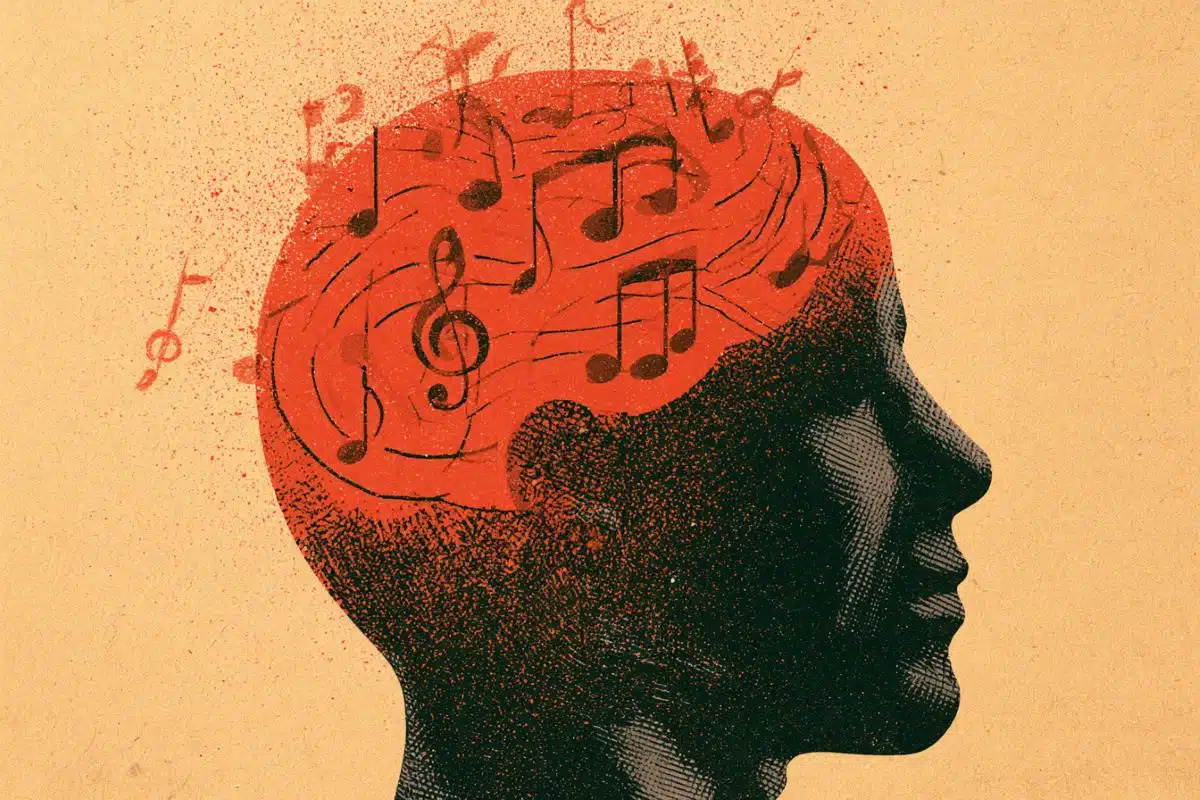
Summary: A neuroscience study demonstrates that musical melodies imagined in the human brain can be decoded and reconstructed using surface electrode brain signals.
The study analyzed invasive brain activity from ten epilepsy patients undergoing clinical intracranial monitoring. Participants listened to the opening bars of familiar children’s songs, mentally imagined the continuation of the melodies, and subsequently hummed them aloud.
By targeting brain signals encoding relative pitch classes (such as do, re, mi), the research team successfully reconstructed the melodic contours of the imagined music over time. The findings provide direct neural evidence for internal musical representation and offer a foundation for developing music-based brain-computer interfaces for non-verbal populations.
Key Facts
- Neural Decoding of Imagined Pitch: Invasive brain signals carry sufficient spectral and temporal information to decode relative pitch sequences during silent mental musical imagery.
- Relative Pitch Class Framework: The predictive decoding model targets relative pitch relationships (such as do, re, mi, fa, sol, la) rather than absolute auditory frequencies, mimicking human perceptual invariance across different musical keys.
- Sequential Contour Reconstruction: Aggregating note-level neural pitch predictions across time allowed researchers to reconstruct accurate melodic trajectories of imagined songs.
- Assistive Technology Horizon: Offers proof-of-concept for future brain-computer interfaces designed to synthesize internally imagined music or speech for individuals with severe motor or speech impairments, such as Amyotrophic Lateral Sclerosis.
Source: SfN
In a study led by Jii Kwon and Chun Kee Chung, from Seoul National University, researchers explored whether they could recreate melodies from the brain activity of people imagining how songs continue after listening to a few bars.
The researchers’ work is published in eNeuro.
Study participants were 10 epilepsy patients with electrodes on the surfaces of their brains for clinical monitoring purposes. Participants quietly listened to the first bars of children’s tunes, then imagined the melodies of subsequent bars of the songs before humming their imagined melodies. Brain activity from the patients carried information about relative pitches within the imagined melodies.
Combining note-level pitch predictions over time allowed the research team to recreate melodic changes that reflected the structure of the imagined songs.
Kwon elaborates, “The model we created decodes relative pitch classes—such as do, re, mi, fa, sol, and la—rather than exact, absolute pitches. This is useful because people often recognize melodies by the relationships between notes, even when the same melody is played in a different key.”
According to the authors, this study provides evidence that brain signals reveal the pitches of notes in imagined musical melodies. These findings may motivate future work on decoding other musical attributes, such as tempo and dynamics, or exploring whether similar approaches can extend beyond familiar children’s songs to more complex music.
Kwon hopes these findings may eventually help develop ways of reconstructing imagined melodies for individuals with little music background or even patient populations—such as those with Amyotrophic Lateral Sclerosis—who cannot articulate what they are imagining.
Key Questions Answered:
A: Researchers recorded intracranial brain activity from ten epilepsy patients who already had electrodes placed on the surface of their brains for clinical seizure monitoring. The participants listened to the beginning of familiar songs, silently imagined how the music continued, and then hummed the tune to confirm accuracy.
A: Humans recognize songs based on the interval relationships between notes rather than absolute pitch frequencies. By training the decoding model on relative pitch classes (do, re, mi), the algorithm mirrors human musical perception and remains effective even if a melody is imagined in a different key.
A: Beyond advancing auditory neuroscience, the technology could serve as the foundation for communication neuroprosthetics. Future iterations could allow individuals with motor neuron diseases like Amyotrophic Lateral Sclerosis, who cannot speak or articulate sound, to express thoughts or musical ideas directly through a neural interface.
Editorial Notes:
- This article was edited by a Neuroscience News editor.
- Journal paper reviewed in full.
- Additional context added by our staff.
About this music and neuroscience research news
Author: SfN Media
Source: SfN
Contact: SfN Media – SfN
Image: The image is credited to Neuroscience News
Original Research: The findings will appear in eNeuro


