

People are intuitive physicists, knowing from birth how objects under the influence of gravity are likely to fall, topple or roll. In a new study, scientists have found the brain cells apparently responsible for this innate wisdom.
In a part of the brain responsible for recognizing color, texture and shape, Johns Hopkins University researchers found neurons that used large-scale environmental cues to infer the direction of gravity. The findings, forthcoming this month in the journal Current Biology, and just posted online, suggest these cells help humans orient themselves and predict how objects will behave.
“Gravity is a strong ubiquitous force in our world,” said senior author Charles E. Connor, a professor of neuroscience and director of the university’s Zanvyl Krieger Mind/Brain Institute. “Our results show how the direction of gravity can be derived from visual cues, providing critical information about object physics as well as additional cues for maintaining posture and balance.”
Connor, along with lead author Siavash Vaziri, a former Johns Hopkins postdoctoral fellow, studied individual cells in the object area of the rhesus monkey brain, a remarkably close model for the organization and function of human vision. They measured responses of each cell to about 500 abstract three-dimensional shapes presented on a computer monitor. The shapes ranged from small objects to large landscapes and interiors.
They found that a given cell would respond to many different stimuli, especially large planes and sharp, extended edges. What tied these stimuli together was their alignment in the same tilted rectilinear reference frame. These cells, sensitive to different tilts, could provide a continuous signal for the direction of gravity, even as a person constantly moves.
In other words, Connor said, these neurons could help people understand which way is up.
“The world does not appear to rotate when the head tilts left or right or gaze tilts up or down, even though the visual image changes dramatically,” he said. “That perceptual stability must depend on signals like these that provide a constant sense of how the visual environment is oriented.”
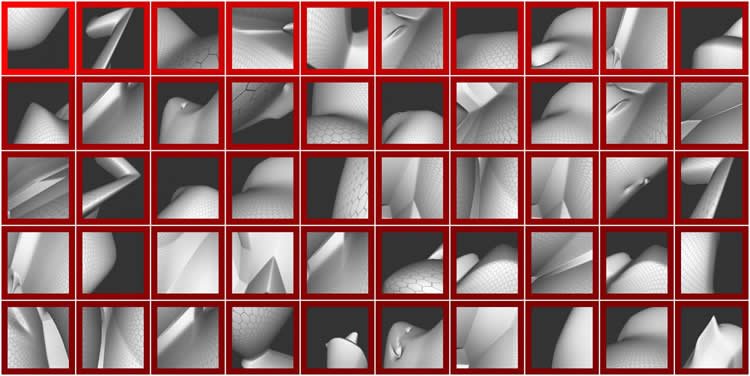
The researchers’ initial discovery of cells sensitive to large-scale shape, reported in Neuron in 2014, was surprising because they found them in a brain region long regarded as dedicated exclusively to object vision. The new findings make sense of this anatomical juxtaposition, since knowing the gravitational reference frame is critical for predicting how objects will behave.
“When we dive after a ball in tennis, the whole visual world tilts, but we maintain our sense of how the ball will fall and how to aim our next shot,” Connor said. “The visual cortex generates an incredibly rich understanding of object structure, materials, strength, elasticity, balance, and movement potential. These are the things that make us such expert intuitive physicists.
Funding: The study was supported by National Institutes of Health grant EY024028.
Source: Jill Rosen – Johns Hopkins University
Image Source: The image is credited to Johns Hopkins University.
Original Research: Abstract for “Representation of Gravity-Aligned Scene Structure in Ventral Pathway Visual Cortex” by Siavash Vaziri and Charles E. Connor in Current Biology. Published online January 9 2016 doi:10.1016/j.cub.2016.01.022
Abstract
Representation of Gravity-Aligned Scene Structure in Ventral Pathway Visual Cortex
Highlights
•Object- and scene-selective ventral pathway neurons differ markedly in shape tuning
•Individual scene-selective neurons respond to a diversity of planes and edges
•These diverse stimuli are typically related by a common rectilinear reference frame
•These neurons could represent a gravity-related reference frame for object vision
Summary
The ventral visual pathway in humans and non-human primates is known to represent object information, including shape and identity. Here, we show the ventral pathway also represents scene structure aligned with the gravitational reference frame in which objects move and interact. We analyzed shape tuning of recently described macaque monkey ventral pathway neurons that prefer scene-like stimuli to objects. Individual neurons did not respond to a single shape class, but to a variety of scene elements that are typically aligned with gravity: large planes in the orientation range of ground surfaces under natural viewing conditions, planes in the orientation range of ceilings, and extended convex and concave edges in the orientation range of wall/floor/ceiling junctions. For a given neuron, these elements tended to share a common alignment in eye-centered coordinates. Thus, each neuron integrated information about multiple gravity-aligned structures as they would be seen from a specific eye and head orientation. This eclectic coding strategy provides only ambiguous information about individual structures but explicit information about the environmental reference frame and the orientation of gravity in egocentric coordinates. In the ventral pathway, this could support perceiving and/or predicting physical events involving objects subject to gravity, recognizing object attributes like animacy based on movement not caused by gravity, and/or stabilizing perception of the world against changes in head orientation. Our results, like the recent discovery of object weight representation, imply that the ventral pathway is involved not just in recognition, but also in physical understanding of objects and scenes.
“Representation of Gravity-Aligned Scene Structure in Ventral Pathway Visual Cortex” by Siavash Vaziri and Charles E. Connor in Current Biology. Published online January 9 2016 doi:10.1016/j.cub.2016.01.022


