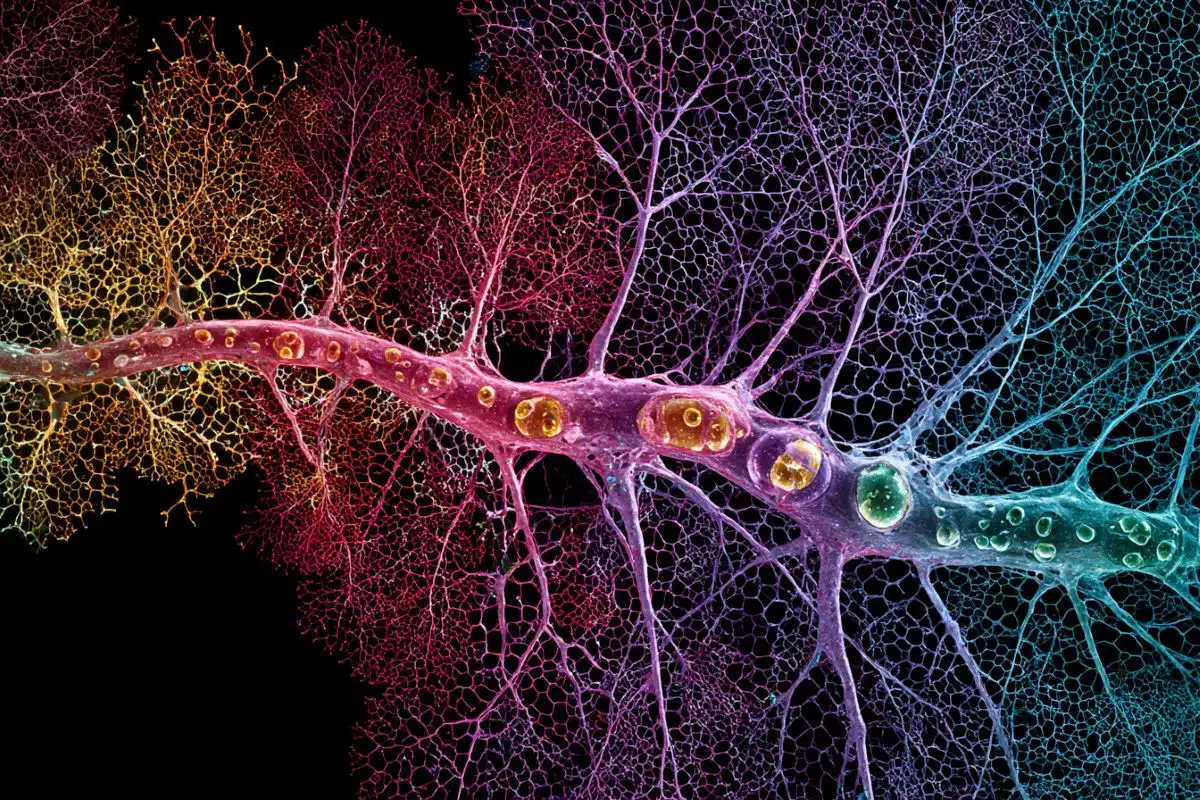
Summary: Researchers demonstrated for the first time that genes encode a comprehensive “wiring map” that directs neurons to their correct destinations across the entire brain.
The study utilized a new machine learning tool called SPERRFY to prove that neural connections are guided by overlapping patterns of gene activity. This research validates and expands upon the 60-year-old chemoaffinity theory, suggesting that the same molecular GPS used in simple sensory circuits actually organizes the complex connectivity of the whole brain.
Key Facts
- SPERRFY Decoding: The researchers developed SPERRFY, an analysis method that combined a map of brain connections with the activity levels of 763 genes across 213 brain regions in mice.
- Predictive Power: By identifying “gene expression gradients,” the algorithm predicted brain connectivity with a high performance score of 0.88, significantly outperforming predictions based solely on physical distance (0.70).
- Two-Level Organization: The study revealed that broad gene patterns determine the overall organization between brain regions, while more detailed patterns regulate specific connections within them.
- Whole-Brain Validation: The findings provide the first large-scale computational proof for Roger Sperry’s 1963 chemoaffinity theory, confirming it applies to the entire brain rather than just simple circuits like vision.
Source: Nagoya University
How complex neural circuits are genetically designed and wired is a fundamental question in neuroscience. Scientists have shown for the first time that genes encode a “wiring map” that guides neurons to connect with the correct brain regions.
The findings, based on machine learning analysis of mouse brain data, were published in Proceedings of the National Academy of Sciences, and offer new avenues for research into brain development and disease.

Mapping connections between brain regions with data
The research team, led by scientists from Nagoya University in Japan, aimed to understand the wiring rules that guide nerve fibers during brain development. These long, thin fibers, called axons, extend from neurons and send signals to other neurons.
The researchers developed an analysis method called SPERRFY that combines two datasets. One dataset maps which brain regions are connected to each other, and the other tracks the activity levels of 763 genes in all 213 brain regions in mice.
“Some genes are highly active in certain brain regions and less active in others. These differences create distinct patterns of gene activity throughout the brain,” said Naoki Honda, senior author and professor from Nagoya University’s Graduate School of Medicine.
“When hundreds of patterns overlap, they give each brain region a unique molecular identity. These identities are what SPERRFY was designed to decode.”
By feeding both datasets into a machine learning algorithm, SPERRFY identified these patterns of gene activity, called gene expression gradients, that predict which brain regions are likely to connect.
For each pair of connected brain regions, SPERRFY paired the gene activity profile of the source region (where the nerve fiber originates) with the profile of the target region it connects to.
From these gene expression gradients, the researchers produced a brain wiring map that tells each brain region where it is relative to every other region. Overlapping patterns of gene activity reconstructed the brain’s connection patterns with a prediction-performance score of 0.88 on a 0-to-1 scale, where 1.0 indicates perfect prediction. By comparison, predictions based only on the physical distance between brain regions scored about 0.70.
Additionally, the researchers discovered that the brain’s wiring map operates on two levels. Broad gene activity patterns determine the overall organization between brain regions, while more detailed patterns regulate the specific connections within them.
Testing a 60-year-old theory on the whole brain
The findings build on the chemoaffinity theory proposed by Nobel laureate Roger Sperry in 1963. He suggested that neurons find their connection partners by following molecular concentration gradients — chemical signals that vary in strength throughout the brain. These gradients act like a GPS system for growing nerve fibers.
“The chemoaffinity theory was well established for simple circuits such as the visual and olfactory systems. But until now, the complexity of whole-brain connectivity made it difficult to test whether the same principle operates across the brain,” said Jigen Koike, first author and former PhD student at Hiroshima University, who also conducted research as a special research student at Nagoya University’s Graduate School of Medicine.
This complexity made it extremely difficult to test Sperry’s theory across the entire brain without computational tools. Using machine learning, the researchers developed the tools to do this for the first time. Their findings support the idea that this long-standing principle is not limited to simple sensory circuits, but also helps explain how connections are organized across the whole brain.
Future research
By comparing the activity of 763 genes against the wiring map, SPERRFY also identified specific genes with activity patterns that closely matched, including genes known to guide nerve growth. This supports the validity of the method and provides a starting point for research on the molecular mechanisms of brain wiring.
The researchers note that their method can be applied to any species for which maps of the brain’s neural circuits and gene expression data are available, such as humans, marmosets, and fruit flies.
As these datasets expand, the method could help determine if the same molecular wiring principles are shared across species and how they have evolved. SPERRFY could also assist scientists in understanding how disruptions in brain wiring contribute to neurodevelopmental disorders.
Key Questions Answered:
A: Think of it like a GPS system. Each brain region has a unique “molecular identity” created by hundreds of overlapping gene activity patterns. These gradients tell the growing nerve fibers exactly where they are located relative to every other region.
A: Proposed by Nobel laureate Roger Sperry in 1963, it suggests that neurons find their partners by following chemical signals that vary in strength throughout the brain. Until now, we only knew this worked for simple systems like eyes or noses; this study proves it works for the whole brain.
A: Yes. SPERRFY can be applied to any species that has mapped neural circuits and gene expression data, including humans, marmosets, and fruit flies. This could eventually help us understand how “mis-wirings” lead to neurodevelopmental disorders.
Editorial Notes:
- This article was edited by a Neuroscience News editor.
- Journal paper reviewed in full.
- Additional context added by our staff.
About this brain mapping and genetics research news
Author: Merle Naidoo
Source: Nagoya University
Contact: Merle Naidoo – Nagoya University
Image: The image is credited to Neuroscience News
Original Research: Open access.
“A data-driven framework linking the connectome to spatial gene expression gradients inspired by chemoaffinity theory” by Jigen Koike, Ken Nakae, Riichiro Hira, Yuichiro Yada, and Naoki Honda. PNAS
DOI:10.1073/pnas.2516572123
Abstract
A data-driven framework linking the connectome to spatial gene expression gradients inspired by chemoaffinity theory
Understanding how brain-wide neural circuits are genetically wired remains a fundamental question in neuroscience.
While Sperry’s chemoaffinity theory [Sperry, Proc. Natl. Acad. Sci. U.S.A. 50, 703–710 (1963)] posits that molecular gradients provide positional cues for axonal projections, its application has been largely limited to localized sensory systems.
Here, we present SPERRFY (Spatial Positional Encoding for Reconstructing Rules of axonal Fiber connectivitY), a data-driven framework that operationalizes Sperry’s theory at the whole-brain scale.
By integrating connectomic data with spatial transcriptomic profiles from the Allen Mouse Brain Atlas, SPERRFY infers latent positional gradients that underlie axonal wiring.
Using canonical correlation analysis (CCA), we extract top gradient pairs that align with observed neural connectivity patterns, capturing both global (interregional) and local (intraregional) organizational principles.
Connectivity reconstruction based on these gradients shows strong predictive performance, and permutation-based null models confirm the biological relevance of the inferred structures.
Furthermore, SPERRFY can screen for candidate genes that may contribute to positional wiring information, providing molecular insight into the developmental logic of brain-wide circuitry.
Our results extend Sperry’s foundational theory beyond the sensory domain, offering a unified, data-driven framework for understanding genetically encoded connectivity across the entire brain.