

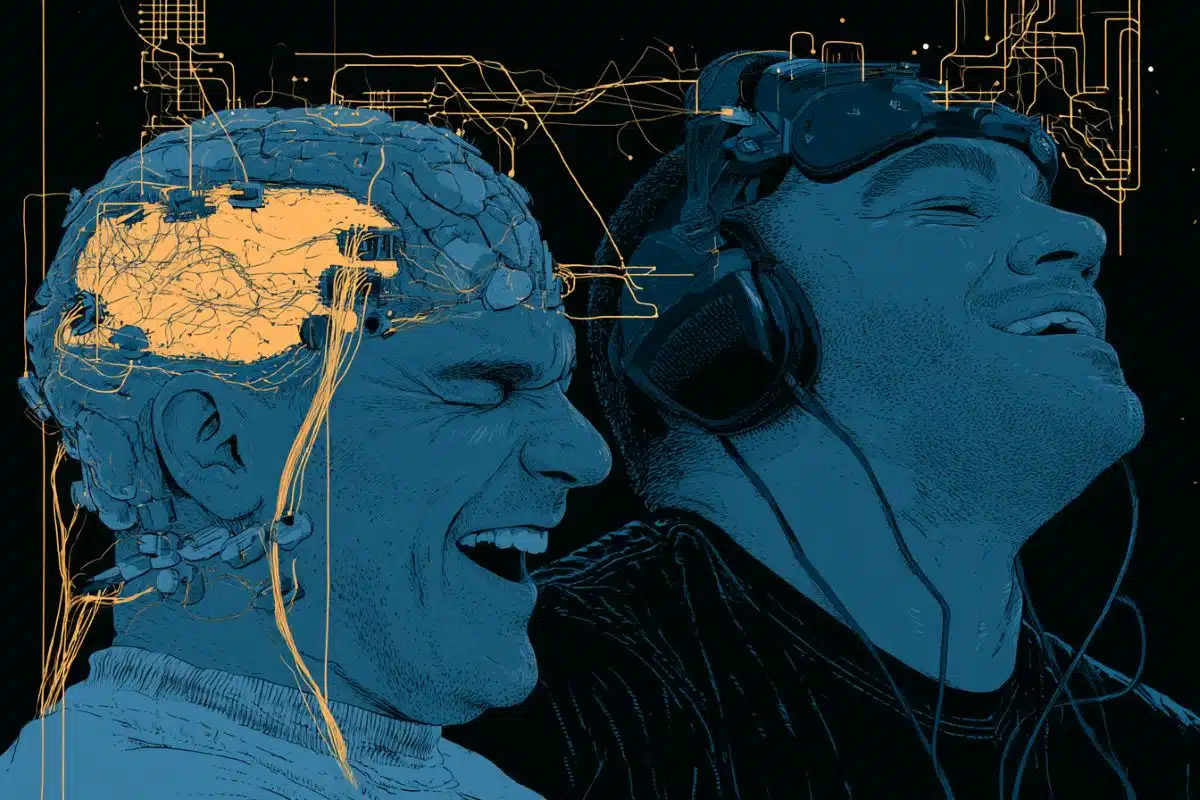
Summary: Laughter is one of humanity’s most universal social signals, yet tracing its exact neurological architecture has long eluded scientists due to the extreme difficulty of evoking genuine, unforced mirth in a sterile laboratory environment.
In a comprehensive review, an international research team resolved this experimental bottleneck by analyzing clinical data from awake pre-surgical epilepsy patients. During these delicate procedures, localized electrical stimulation of specific brain structures inadvertently triggered involuntary laughter, allowing patients to report their subjective emotional states in real-time.
Key Facts
- The Dual-Network Architecture: Human laughter is managed by two anatomically distinct pathways: a deep, emotional spontaneous network and a cortical, motor-driven volitional network.
- Awake Surgical Mapping: The data relies heavily on pre-surgical cortical mapping in awake epilepsy patients. Electrical stimulation of specific nodes unintentionally induced physical laughter, giving scientists a pristine view of localized neural control.
- Spontaneous Network & Mirth: Stimulating the spontaneous network, including the pregenual anterior cingulate cortex, nucleus accumbens, and the temporal pole, produces intense, authentic laughter accompanied by feelings of genuine euphoria and mirth.
- Volitional Network & Mechanics: Stimulating the voluntary network, including the rolandic operculum, globus pallidus, and presupplementary motor area, evokes physical laughing and smiling movements completely devoid of any positive emotions or mood alteration.
- The Evolution of Play vs. Speech: The spontaneous system represents an ancient mammalian survival pathway born from “rough-and-tumble” play to mitigate aggression. Conversely, the voluntary system overlaps directly with modern human speech networks to modulate rapid conversational cues.
- The Analgesic Connection: The spontaneous laughter pathway heavily utilizes the anterior cingulate cortex, a crucial regulatory node in the brain’s internal pain-dampening (analgesic) system, validating why laughter physically elevates pain thresholds.
Source: Cell Press
Laughter is a universal social signal that connects us with others, but the brain regions underlying laughter are not well understood, in part because it’s hard to elicit genuine laughter in the lab.
In a review publishing on June 23 in the Cell Press journal Trends in Neurosciences, researchers analyze reports from medical procedures in which the brain is electrically stimulated in awake patients. Laughter can be an unintentional byproduct of these stimulations, allowing scientists to pinpoint laughter-evoking brain areas.
By examining these reports and other clinical and animal studies, the authors describe two distinct networks in the brain for laughter: one that elicits spontaneous outbursts, and another that produces voluntary, conversational laughter.
Researchers have long observed two types of laughter in healthy humans. “Think about the last time you were laughing and you could not stop,” says author Sophie Scott of University College London, London, UK. “Something set of you off and you are helpless with mirth.”
That, she says, is spontaneous, involuntary, and sometimes uncontrollable laughter, which can be associated with certain types of seizure disorders, mood disorders, Alzheimer’s disease, and schizophrenia.
The second kind is volitional laughter. “That’s most of the laughter you encounter,” says Scott. “It’s timed incredibly precisely. If you look at people having a conversation, they will laugh together at the end of a sentence and then breathe together.”
“When people are talking to each other, volitional laughter starts and stops really quickly,” says Scott. This type of coordination points to a degree of control that is lacking in spontaneous laughter.
To tease apart the brain circuitry underlying these two types of laughter, the team turned to reports of pre-surgical brain stimulation in epilepsy patients. During these procedures, clinicians identify brain regions to target for surgery by electrically stimulating parts of the brain while patients are awake. These probes often unintentionally evoke laughter, and patients are able to describe their feelings in real time.
The authors analyzed these reports, along with other clinical and animal studies, to propose two distinct networks underlying spontaneous and voluntary laughter. The spontaneous network consists of brain regions involved in motor control and emotional regulation, including the pregenual anterior cingulate cortex, nucleus accumbens, and the temporal pole. Stimulating these regions produces laughter accompanied by enhanced mood, euphoria, and mirth.
The voluntary network comprises areas involved purely in motor control of laughing and smiling, such as the rolandic operculum, globus pallidus, and presupplementary motor area. Stimulation of these regions evokes laughter without positive emotions.
The authors suggest that the spontaneous network is a more evolutionarily ancient pathway that arose in animal “rough-and-tumble” play, with laughter-like vocalizations serving as a signal to prevent aggression and promote social bonding. This hypothesis is consistent with recent discoveries that several mammalian species produce laughter-like vocalizations during social interactions.
The voluntary network, on the other hand, overlaps with brain regions that produce speech, supporting the idea that it controls more purpose-driven, conversational laughter.
In addition to shedding light on neurological and psychiatric disorders marked by altered laughter, the authors hope the findings can serve “as a kind of Rosetta stone for decoding multiple aspects of communication and the social use of vocalizations,” particularly in the context of linguistics and conversation analysis, says author Fausto Caruana of the National Research Council of Italy, Parma, Italy.
“The role of these circuits in pain modulation is also intriguing,” Caruana says. Studies have shown that laughter can act as a natural analgesic. And the anterior cingulate, identified in this literature review as part of the spontaneous laughter network, is also an important player in the brain’s own pain-dampening system.
“We are interested in further investigating the analgesic role of laughter and the neural circuits that support it,” Caruana says.
Key Questions Answered:
A: Evoking authentic, uninhibited laughter inside a rigid laboratory scanner is notoriously difficult. To bypass this, researchers turned to clinical reports of pre-surgical brain mapping for epilepsy. Because patients remain completely awake during these procedures to help surgeons identify critical tissue boundaries, clinicians use micro-electrical probes to stimulate localized brain regions. When these probes hit specific nodes, they unintentionally trigger laughter, allowing the patient to tell the surgical team exactly whether they are experiencing true internal joy or just a mechanical muscle reflex.
A: Spontaneous laughter is an evolutionarily ancient survival mechanism. It shares deep lineage roots with the “rough-and-tumble” play vocalizations observed across multiple mammalian species. In early social structures, this unforced vocal signal served as an immediate acoustic message to group members that an interaction was playful and benign, successfully preventing escalating territorial aggression while fortifying vital social bonds.
A: Volitional laughter is a highly structured communicative tool. Unlike spontaneous laughter, which leaves a person helpless with mirth, volitional laughter must be turned on and off with millisecond-level precision during normal dialogue. Because it functions to grease the wheels of human conversation, such as laughing right at the end of an interlocutor’s sentence and coordinating a mutual breath immediately afterward, it has naturally adapted to share the exact same cortical motor-control networks that govern language production.
Editorial Notes:
- This article was edited by a Neuroscience News editor.
- Journal paper reviewed in full.
- Additional context added by our staff.
About this neuroscience and laughter research news
Author: Julia Grimmett
Source: Cell Press
Contact: Julia Grimmett – Cell Press
Image: The image is credited to Neuroscience News
Original Research: Open access.
“The neural basis of laughter” by Fausto Caruana and Sophie K. Scott. Trends in Neurosciences
DOI:10.1016/j.tins.2026.05.002
Abstract
The neural basis of laughter
Behavioral and clinical evidence distinguish two major forms of human laughter: spontaneous, emotionally driven vocalizations and volitional expressions used in social communication.
Progress in the neuroscience of laughter has been limited by the difficulty of capturing spontaneous, natural signals in laboratory settings. Invasive investigations in humans, such as direct electrical stimulation, have provided a unique causal window into its underlying circuitry.
Evidence supports a dual-system framework, in which an evolutionarily ancient cingulo-temporal network drives spontaneous laughter and its social bonding and analgesic functions, while a lateral motor-opercular system co-opts speech networks for volitional expression used in social negotiation and conversation.


