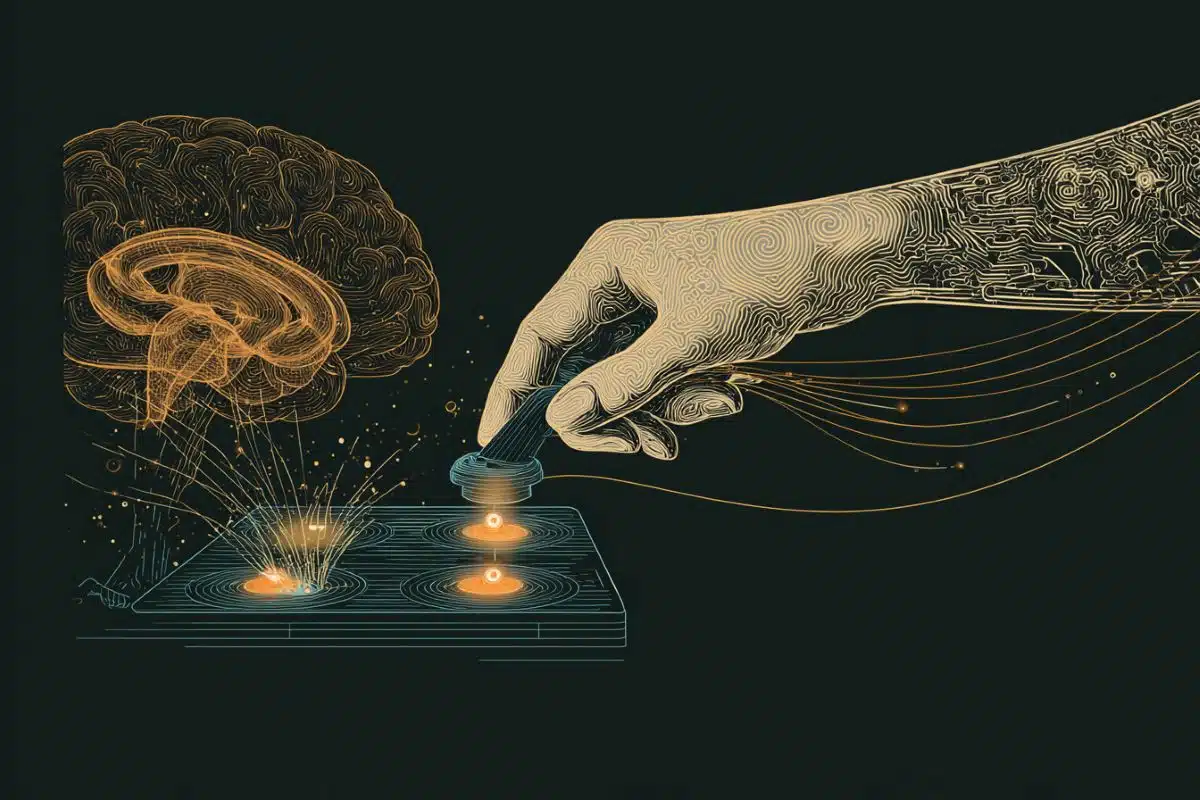
Summary: Unexpected rewards can make people move faster within a fraction of a second, revealing how closely motivation and movement are linked in the brain. In a joystick-based reaching task, participants accelerated toward targets that offered higher reward probability, and their movements gained an extra burst of speed when a low-probability reward appeared unexpectedly.
The timing of this change matched classic dopamine reward-prediction signals, suggesting that movement vigor reflects the brain’s internal value computations. Over time, strings of positive or negative outcomes also shifted overall movement speed, showing that recent experience continuously recalibrates how energetically we act. These findings point to movement as a potential noninvasive marker for tracking dopamine function in conditions such as Parkinson’s disease and depression.
Key Facts
- Surprise Speeds Movement: Unexpected rewards increased movement vigor within about 220 milliseconds.
- Reward Probability Matters: People reached faster toward targets more likely to deliver a reward.
- Second Dopamine Signal: Extra speed appeared only when outcomes were uncertain and better than expected.
- Experience Shapes Energy: Repeated successes sped overall movement, while repeated failures slowed it.
- Clinical Potential: Subtle motion changes could help monitor dopamine-related disorders over time.
Source: University of Colorado
New research by engineers at the University of Colorado Boulder aims to get to the bottom of why, as the saying goes, you get a “skip in your step” when you’re happy.
The study highlights the central role that dopamine, a brain chemical associated with reward, seems to play in making people move faster when they want something. The findings could one day help scientists understand and even diagnose a range of human medical conditions, including Parkinson’s disease and depression.
“Anecdotally, we just feel that this is true,” said senior author Alaa Ahmed, professor in the Paul M. Rady Department of Mechanical Engineering at CU Boulder. “When you go to the airport to pick up your parents, you may run to greet them. But if you’re picking up a colleague, you’re probably just going to walk.”
In the new study, she and Colin Korbisch, a former graduate student at CU Boulder, set out to unravel the pathways in the brain that control those sorts of behaviors.
The researchers designed a simple experiment: They asked human subjects to “reach” for a target on a computer screen using a joystick-like device. Those targets dealt out rewards—in this case, a simple flash of light and a beeping sound.
The team discovered that how those rewards exceeded, or failed to meet, expectations changed how the subjects moved, in some cases giving them a little more oomph as they reached.
Those patterns aligned closely with what scientists know about the behavior of dopaminergic neurons—cells in the brain that release dopamine and shape a huge range of human behavior.
The researchers published their findings Feb. 27 in the journal Science Advances.
“Movements are a window to the mind,” Korbisch said. “Normally, you can’t go into the brain and see what the dopaminergic neurons are doing, but movement could reflect those neural computations that are so difficult to disentangle.”
Juice time
Scientists have known for decades that dopamine plays a critical role in helping animals learn.
In the 1990s, for example, neuroscientist Wolfram Schultz conducted seminal studies on dopaminergic activity in primates.
He and his colleagues trained monkeys to expect a reward—maybe a drop of apple juice—when they heard a bell ring. Those same monkeys began to experience a spike in dopamine every time the heard the bell, even before they got their juice.
But when the monkeys heard the bell and didn’t receive any juice, the disappointment also registered in the brain: The animals still experienced an initial spike in dopamine, but that activity dipped when they failed to receive their reward.
Scientists call this pattern a “reward prediction error.” In a sense, the brain is teaching itself which options are worth pursuing, and which can be ignored.
In the current study, Ahmed and Korbisch wanted to see whether those same patterns might affect how we move.
Reach for it
The team had good reason to think they might. Ahmed explained that people with Parkinson’s disease lose many of the dopaminergic neurons in their brains. They also have a lot of trouble moving.
To explore the link between dopamine and movement, the researchers asked human subjects to use the joystick to make a series of reaches toward one of four targets at each corner of a screen. One target gave a reward every time the subjects hit it, while another target never gave rewards. The other two fell in between.
As the team expected, the subjects tended to reach a little faster toward the targets that were more likely to offer a reward.
But the group also discovered something intriguing: If the subjects reached for a target that was unlikely to give a reward, and they unexpectedly got one, their reaching motion suddenly sped up—even after they had already gotten the reward.
This increase in vigor occurred just 220 milliseconds after the subjects heard the beep. The effect was subtle and not something you could spot with the naked eye. But the findings indicate that a pleasant surprise may give people a little extra pep.
The researchers can’t show definitively what is behind that burst of energy. But Ahmed and Korbisch suspect that their subjects were receiving a second jolt of dopamine from the unexpected treat. When the subjects were certain they were going to get a reward, in contrast, they didn’t seem to get a second surge in dopamine after the beep.
“Importantly, this effect wasn’t tied to reward reception alone,” Korbisch said. “If the outcome was certain and known to the individual, we saw no further increase in vigor.”
Past experience mattered, too. If patients got a string of rewards in a row, they started moving faster overall. If they got nothing but bad luck, they slowed down.
Ahmed noted that many medical conditions affect how people move. People with depression, for example, tend to move more slowly than others. She envisions that, one day, medical professionals could use these sorts of trends to help their patients—following how people move across months or years to track their health.
“If you’ve had a good day, you’ll go faster. If you’ve had a bad day, you’ll move slower,” Ahmed said. “It’s basically that skip in your step.”
Key Questions Answered:
A: When a reward was better than expected, participants’ movements became faster within about 220 milliseconds, reflecting internal dopamine-linked reward prediction signals that increase movement vigor.
A: The extra speed appeared only when the outcome was uncertain and pleasantly surprising, indicating that the brain generates an additional motivational signal for better-than-predicted results.
A: Because dopamine disorders often alter how people move, measuring subtle changes in movement speed over time could provide a simple, noninvasive way to track conditions such as Parkinson’s disease or depression.
Editorial Notes:
- This article was edited by a Neuroscience News editor.
- Journal paper reviewed in full.
- Additional context added by our staff.
About this neuroscience research news
Author: Daniel Strain
Source: University of Colorado
Contact: Daniel Strain – University of Colorado
Image: The image is credited to Neuroscience News
Original Research: Open access.
“Rapid Dopaminergic Signatures in Movement: Reach Vigor Reflects Reward Prediction Error and Learned Expectation” by Colin C. Korbisch and Alaa A. Ahmed. Science Advances
DOI:10.1126/sciadv.adz9361
Abstract
Rapid Dopaminergic Signatures in Movement: Reach Vigor Reflects Reward Prediction Error and Learned Expectation
Movements become more vigorous when rewards are expected, suggesting that motivational signals influence motor control. Dopaminergic neurons, known to encode reward expectation and prediction error, are prime candidates for linking value and vigor.
Here, we show that human reach vigor dynamically tracks canonical dopaminergic learning signals not only at movement onset but also during ongoing motion. Using a reaching task with probabilistic rewards (0, 33, 66, and 100%), we observed that peak velocity scaled with expected value.
Crucially, following feedback, reach velocity was transiently invigorated or enervated in proportion to the sign and magnitude of the reward prediction error. Trial-by-trial changes in kinematics reflected value updating, consistent with dopaminergic phasic learning signals.
These results demonstrate that movement vigor is modulated by reward-learning signals on rapid timescales, revealing a real-time behavioral readout of motivational computation in the brain.