Summary: The urgent, ravenous onset of “the munchies” after cannabis use is no longer just a cultural trope—it is a measurable cognitive phenomenon. A collaborative study has pinpointed exactly how THC overrides the brain’s natural “I’m full” signals.
By hijacking the endocannabinoid system in the hypothalamus, cannabis stimulates cannabinoid receptors in the brain to create a feeling of starvation even in subjects who have just eaten. This discovery is a major leap for medicinal science, providing a neurological roadmap for using cannabis to combat appetite loss in patients with HIV, AIDS, or those undergoing chemotherapy.
Key Facts
- Brain-Mediated Hunger: The study proved “the munchies” are triggered by receptors in the brain, not the gut. Blocking cannabinoid receptors in the peripheral nervous system did not stop hunger, but blocking them in the brain did.
- Overriding Satiety: In rat models, sober animals ignored food when full, but “stoned” animals worked as if they were starving, regardless of how much they had already eaten.
- Universal Effect: The hyperphagia (excessive hunger) occurred regardless of the human participants’ age, sex, weight, or how recently they had eaten.
- Unexpected Cravings: While scientists expected cravings for carbs or sweets, beef jerky emerged as one of the top items human participants gravitated toward while intoxicated.
- Reward Valuation: The research shows that cannabis increases both the motivation to find food and the perceived reward value of that food, essentially making every bite feel more satisfying.
Source: Washington State University
The urgent onset of “the munchies” after cannabis use isn’t imaginary – it’s a cognitive response that occurs regardless of sex, age, weight or recent food consumption and could offer clues to help people struggling with appetite loss.
Those findings from a collaborative study, conducted by researchers at Washington State University and the University of Calgary, were recently published in the Proceedings of the National Academy of Sciences (PNAS).
“There are a lot of different diseases, conditions and disorders associated with wasting syndromes and lack of appetite, and this study really supports the idea that cannabis can be used medicinally to increase appetite in people who have conditions like HIV, AIDS, or who are on chemotherapy,” said Carrie Cuttler, a WSU psychology professor.
Led in part by Cuttler, who directs The Health and Cognition (THC) Lab at WSU, and College of Veterinary Medicine professor Ryan McLaughlin, the research was conducted in tandem with Calgary researchers Matthew Hill and Catherine Hume, who ran a similar series of studies using a rat model.
The human clinical trial examined 82 volunteer subjects aged 21 to 62 from the greater Pullman, Wash., community. Each participant was randomly selected to vape either 20 or 40 milligrams of cannabis or a cannabis placebo, the latter of which served as the control group.
“The human study found irrespective of body mass index, time of last food consumption, sex or how much cannabis was consumed, human participants who used cannabis during the trial ate significantly more food,” McLaughlin said.
Of all the food options — spanning carbohydrates to protein to fatty snack foods — some appealed more than others.
“Beef jerky was one of the No. 1 things intoxicated people gravitated toward, which I don’t understand. Honestly, I would have thought chocolate, chips, Rice Krispies treats — things like that,” Cuttler said, noting water was also high on the list of desirable items.
The study examining appetite in rats at the University of Calgary yielded similar findings. Like the human participants, rats were exposed to cannabis in a controlled environment and provided with multiple food options, which they were tasked with pulling a lever to be rewarded food. No matter what the food was, rats that were under the influence consistently pulled levers.
“The sober animals are kind of like, ‘I’m full. Why do I care?’ They don’t put in any effort at all. They barely work in any capacity to get access to food. But you get them stoned again, and even though they’re now full and they’ve eaten, they go right back as if they’re starving,” Hill said.
The study found that the rats’ food preference did not matter.
“The same thing we saw in the humans we saw in the rats. We kind of thought it would make them want to eat carb-rich foods, but that didn’t seem to be the case. It just seemed to be any food,” Hill said.
The study is significant because, on a subject with little scientific support, it helps highlight the physiological mechanisms responsible for appetite stimulation.
Endogenous cannabinoids, also called endocannabinoids, are naturally produced by the body to regulate mood, memory, pain, immune responses and appetite in order to maintain balance.
“That’s what the natural endocannabinoid system does in the hypothalamus,” McLaughlin said. “But THC hijacks that entire system. So even though you’re not necessarily hungry, THC can stimulate cannabinoid receptors in the brain and make you feel hungry.”
The stimulation of those cannabinoid receptors in the brain is another key finding from the research. Pharmacology studies at the University of Calgary that blocked cannabinoid receptors in the peripheral nervous system in rats didn’t curb appetite, but blocking those same cannabinoid receptors in the brain did.
“That’s what really gives us the opportunity to look at whether this is something brain-mediated or gut-mediated, and this generally shows ‘the munchies’ are mediated by the brain,” McLaughlin said.
Knowing hunger stems from receptors in the brain, researchers hope the study can inform future treatments for people experiencing appetite loss.
“There’s very little documentation of the munchies phenomenon, but this paper really starts to tap into some of the mechanisms that might be responsible,” Cuttler said.
Key Questions Answered:
A: Your hypothalamus is the part of the brain that says “I’m full.” THC essentially hijacks those receptors and flips the switch to “starving.” It’s like your brain is tricking your body into thinking it hasn’t eaten for days.
A: Yes. Because the study confirms this effect is brain-mediated and independent of body weight or recent food intake, it supports the use of cannabis as a legitimate medical tool for patients with cancer or HIV who physically cannot feel hunger.
A: Surprisingly, no. While people often think of cookies or chips, the rat studies showed they would work for any food, and humans showed a high preference for protein-heavy items like beef jerky. It’s more about “intensity of hunger” than a specific craving.
Editorial Notes:
- This article was edited by a Neuroscience News editor.
- Journal paper reviewed in full.
- Additional context added by our staff.
About this hunger and cannabis research news
Author: Josh Babcock
Source: Washington State University
Contact: Josh Babcock – Washington State University
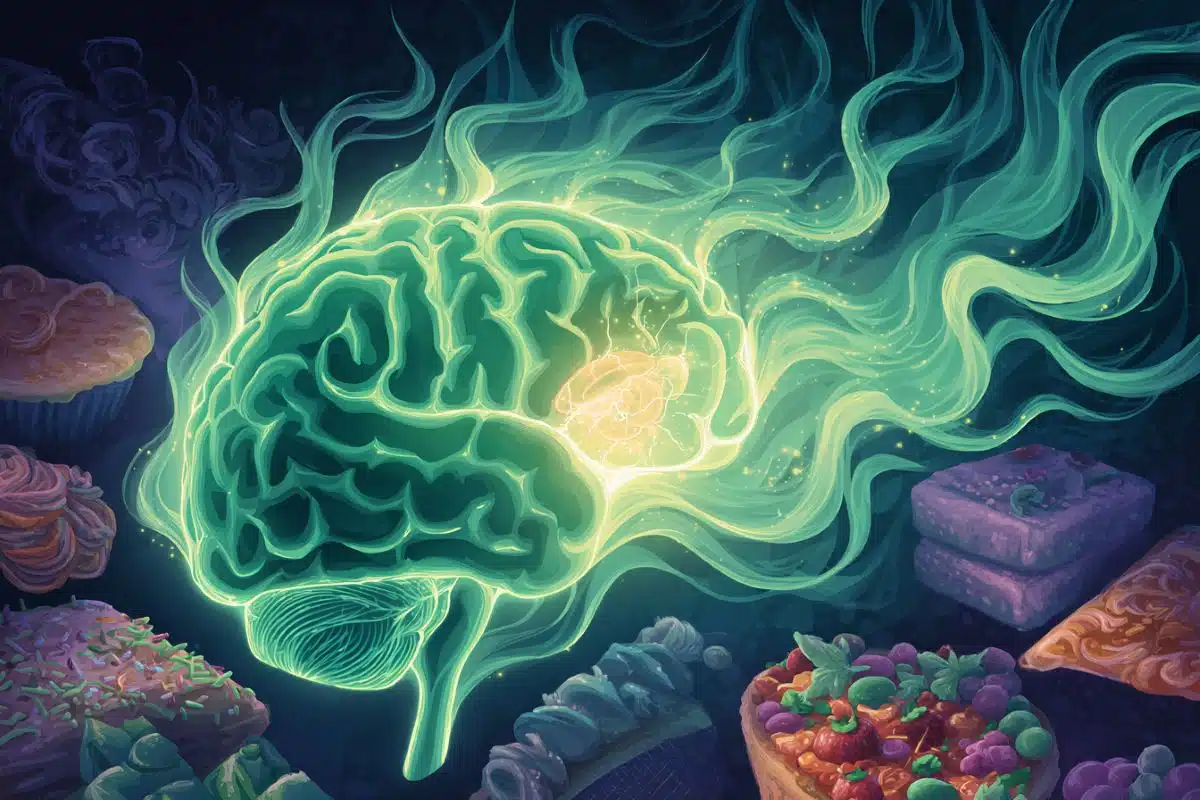
Image: The image is credited to Neuroscience News
Original Research: Closed access.
“Cannabis produces acute hyperphagia in humans and rodents via increased reward valuation for, and motivation to, acquire food” by Catherine Hume, Carrie Cuttler, Samantha L. Baglot, Lucia Javorcikova, Ryan J. McLaughlin, and Matthew N. Hill. PNAS
DOI:10.1073/pnas.2518863122
Abstract
Cannabis produces acute hyperphagia in humans and rodents via increased reward valuation for, and motivation to, acquire food
With approximately 4% of the world’s population using cannabis, there is a need to better understand its physiological effects.
Cannabis consumption acutely promotes food intake (“the munchies”) via delta-9-tetrahydrocannabinol-mediated activation of cannabinoid 1 receptors (CB1R); however, these appetitive effects have not been well characterized.
We examined effects of cannabis vapor inhalation on energy and macronutrient intake patterns in human participants and then validated these findings in a translational rat model through which we explored behavioral and physiological mechanisms subserving this response.
Vaporized cannabis acutely and robustly increased energy intake. In humans, this occurred in the first 30 min of snack and beverage access, irrespective of dose or gender. In rats, these effects were observed in the first 60 min of food access, irrespective of macronutrient content, satiation, or sex, and were a result of cannabis vapor reducing latency to eat and increasing feeding bout number.
Also, cannabis vapor did not change the proportion of macronutrients consumed by human participants and abolished preexisting macronutrient-specific food preferences in rats.
Our rat data indicate that cannabis vapor may override homeostatic appetite regulation by increasing motivation to eat and reducing food reward devaluation to promote energy intake.
Finally, cannabis vapor did not alter circulating appetite-associated hormones, and these feeding effects were mediated by central, but not peripheral, CB1Rs.
This study complements and builds upon previous literature to characterize the appetitive effects of vaporized cannabis and uses a translational approach to examine cannabis-driven energy and macronutrient intake patterns in humans and rodents.