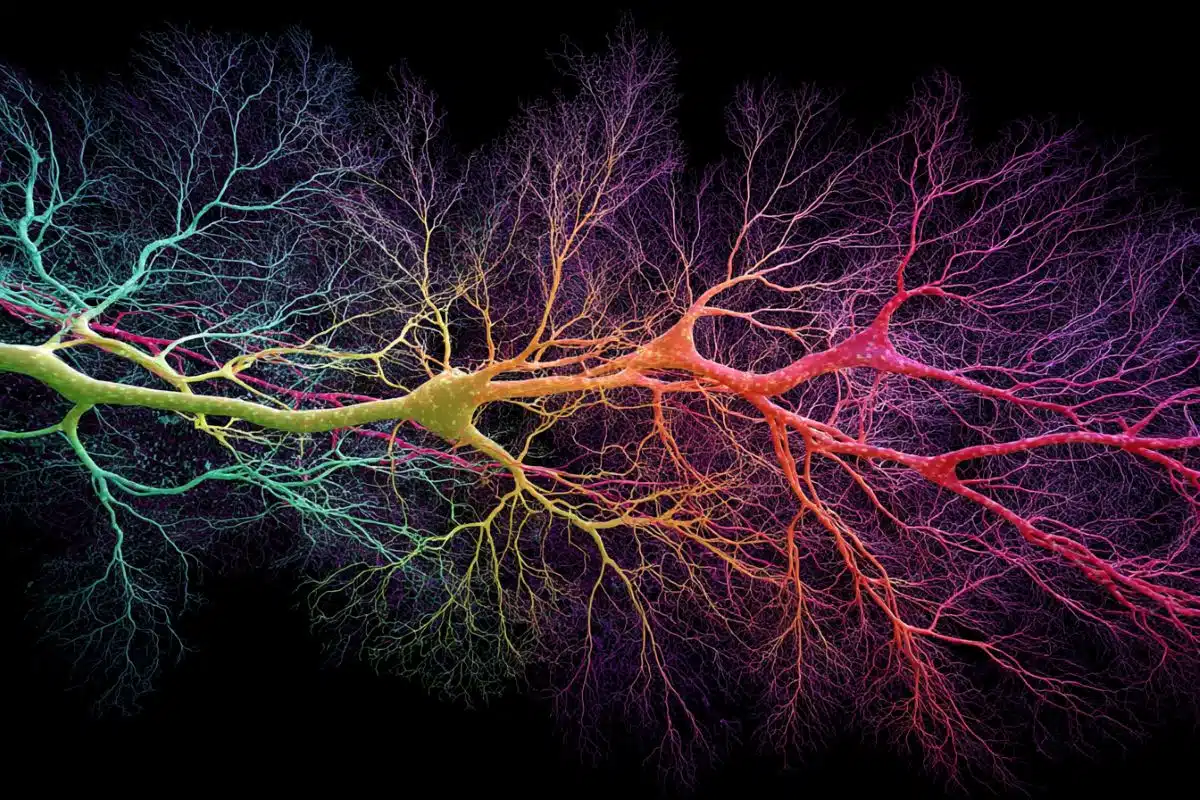
Summary: Neurons are the ultimate logistical challenge of the biological world. To maintain their long, complex structures, they must deliver specific proteins to exact locations—like the Axon Initial Segment (AIS)—with pinpoint accuracy. A major study has finally unraveled how “motor proteins” know which cargo to pick up.
The team discovered that the motor family Kinesin-2 isn’t just one machine; it actually builds specialized “subtypes” by swapping out its parts. By forming a unique KIF3B/B/KAP3 complex, the motor specifically recognizes and hauls TRIM46, a critical protein that acts as the “architect” for neuronal polarity.
Key Facts
- Cargo Selectivity Solved: For decades, scientists knew how motors walked, but not how they “chose” their luggage. This study proves that the molecular makeup of the motor’s tail determines which protein it can grab.
- The AIS Destination: The Axon Initial Segment (AIS) is the “control center” where electrical signals begin. Without the precise delivery of the TRIM46 protein to this spot, neurons lose their polarity and fail to function.
- The “B/B” Subtype: While the standard motor uses a KIF3A/B mix, the researchers found a specialized KIF3B/B/KAP3 version. This specific assembly is the only one capable of transporting TRIM46.
- Transport vs. Production: When the KIF3B motor was disabled, the cell still produced TRIM46, but the protein just floated aimlessly. It couldn’t reach its “job site,” proving that transport defects—not lack of protein—cause the structural failure.
- Clinical Significance: Many neurodevelopmental and neurodegenerative disorders are essentially “shipping errors.” Understanding these motor subtypes could lead to therapies that fix broken transport lines in the brain.
Source: Juntendo University
Intracellular transport is a vital process that allows cells to move proteins and other molecules to specific locations. This process is especially important in neurons, which have highly polarized structures with long extensions such as axons and dendrites.
For neurons to function properly, proteins must be transported accurately to specific regions, such as the axon initial segment (AIS), a specialized site for initiating electrical signals. Despite its importance, how motor proteins selectively recognize and transport specific cargo molecules has remained an open question in cell biology.
Kinesin superfamily proteins (KIFs) are microtubule-dependent molecular motors that drive intracellular transport by carrying diverse cargo, including organelles and signaling molecules, along cellular tracks.
Among these, the kinesin-2 family typically consists of KIF3A, KIF3B, and kinesin-associated protein 3 (KAP3). However, it remains unclear whether variations in their assembly influence cargo selectivity.
In a recent study, a team of researchers led by Professor Nobutaka Hirokawa from the Graduate School of Medicine, Juntendo University, Japan, along with Dr. Xuguang Jiang, a JSPS Postdoctoral Fellow, Dr. Sotaro Ichinose from Gunma University, Japan, and Dr. Tadayuki Ogawa from Dokkyo Medical University, Japan, discovered a previously unrecognized mechanism that regulates cargo-specific transport in neurons.
The study was published online on March 30, 2026, and is scheduled to be published in Volume 225, Issue 5 of the Journal of Cell Biology on May 04, 2026.
Explaining the motivation behind the study, Prof. Hirokawa says, “While many studies have revealed how kinesin motor proteins move along microtubules, a key unanswered question has been how they recognize and selectively transport specific cargo molecules.”
He adds, “Neurons provide a particularly compelling system to study this because they require extremely precise intracellular transport to maintain their highly polarized structure.”
In this vein, the research team employed a combination of neuronal cell biology, biochemical reconstitution, and structural analyses. Using cultured neurons and mouse brain samples, they examined the composition and distribution of kinesin-2 motor complexes.
They also used gene knockdown and knockout approaches to evaluate the role of specific motor components in transporting TRIM46, a protein that accumulates at the AIS and is essential for establishing neuronal polarity.
Their findings revealed that kinesin-2 is not a single, uniform motor complex. Instead, it forms multiple molecular subtypes with distinct compositions and functions. In addition to the canonical KIF3A/B/KAP3 complex, the researchers identified a KIF3B/B/KAP3 complex that preferentially associates with TRIM46 and facilitates its transport to the AIS.
Importantly, when KIF3B was depleted, TRIM46 failed to accumulate properly at the AIS, even though its overall levels within the cell remained unchanged. This indicated that the defect arises from impaired transport rather than reduced protein production. Further structural analyses suggested that differences in the tail domains of these motor complexes may determine their cargo-binding specificity.
Beyond advancing fundamental understanding, the study also has important implications for human health. Defects in intracellular transport are associated with a wide range of neurological and neurodevelopmental disorders. Proper delivery of proteins, such as TRIM46, is essential for maintaining neuronal polarity, synaptic function, and neural circuit formation.
Emphasizing the broader impact, Prof. Hirokawa says, “By identifying how kinesin-2 motors selectively transport proteins to specific neuronal regions, our study provides important insights into the molecular mechanisms that organize neuronal architecture.”
He adds, “In the long term, understanding how motor proteins recognize and deliver specific cargo could help guide the development of therapeutic strategies targeting transport defects.”
In addition to its relevance in neuroscience, this work contributes to a broader understanding of intracellular transport systems. The discovery that motor protein composition can regulate cargo specificity introduces a new conceptual framework for studying how cells organize their internal logistics.
These insights may also inspire future applications in biotechnology and nanotechnology, where engineered systems mimic biological transport processes.
Overall, this study demonstrates that diversity in motor protein assemblies plays a crucial role in achieving precise intracellular transport. By uncovering how neurons regulate cargo delivery with such specificity, these findings provide fresh insights into neuronal development and disease.
Key Questions Answered:
A: Neurons are incredibly long—if a protein had to drift (diffuse) from the center of a human neuron to the end of an axon, it could take years. Active transport via kinesin motors is like a high-speed rail system that delivers the “building materials” in minutes.
A: It loses its sense of direction. Without TRIM46 being delivered to the AIS, the neuron can’t properly distinguish its axon from its dendrites. This “polarity failure” means the neuron can’t send electrical signals, leading to disrupted neural circuits and potential developmental disorders.
A: That is the ultimate goal. By identifying the specific “tail code” that allows a motor to pick up a protein, scientists hope to eventually design synthetic motors that can carry specific therapeutic drugs to a precise location inside a diseased neuron.
Editorial Notes:
- This article was edited by a Neuroscience News editor.
- Journal paper reviewed in full.
- Additional context added by our staff.
About this neuroscience research news
Author: Toshifumi Asano
Source: Juntendo University
Contact: Toshifumi Asano – Juntendo University
Image: The image is credited to Neuroscience News
Original Research: Closed access.
“The KIF3B/B/KAP3 tail domain specifically facilitates TRIM46 transport to the axon initial segment” by Xuguang Jiang, Sotaro Ichinose, Tadayuki Ogawa, Kento Yonezawa, Nobutaka Shimizu, and Nobutaka Hirokawa. Journal of Cell Biology
DOI:10.1083/jcb.202503138
Abstract
The KIF3B/B/KAP3 tail domain specifically facilitates TRIM46 transport to the axon initial segment
Intracellular transport is essential for neuronal organization, yet how motor proteins achieve cargo selectivity remains incompletely understood.
Kinesin-2 motors transport diverse cargos through the heterotrimeric KIF3/KAP3 complex, but whether variations in assembly composition contribute to functional specificity has been unclear.
This study provides evidence for heterogeneity in neuronal KIF3/KAP3 assemblies, including a KIF3B-enriched, KAP3-associated population in addition to the canonical KIF3A/B/KAP3 complex.
Biochemical and cellular analyses support a preferential association between this KIF3B-enriched assembly and TRIM46, a protein required for axon initial segment organization.
Structural analyses further suggest that differences in tail conformation accompany distinct assembly states and may underlie cargo selectivity.
Together, these findings support a model in which compositional and structural diversity within kinesin-2 complexes contributes to spatially regulated transport during neuronal development.