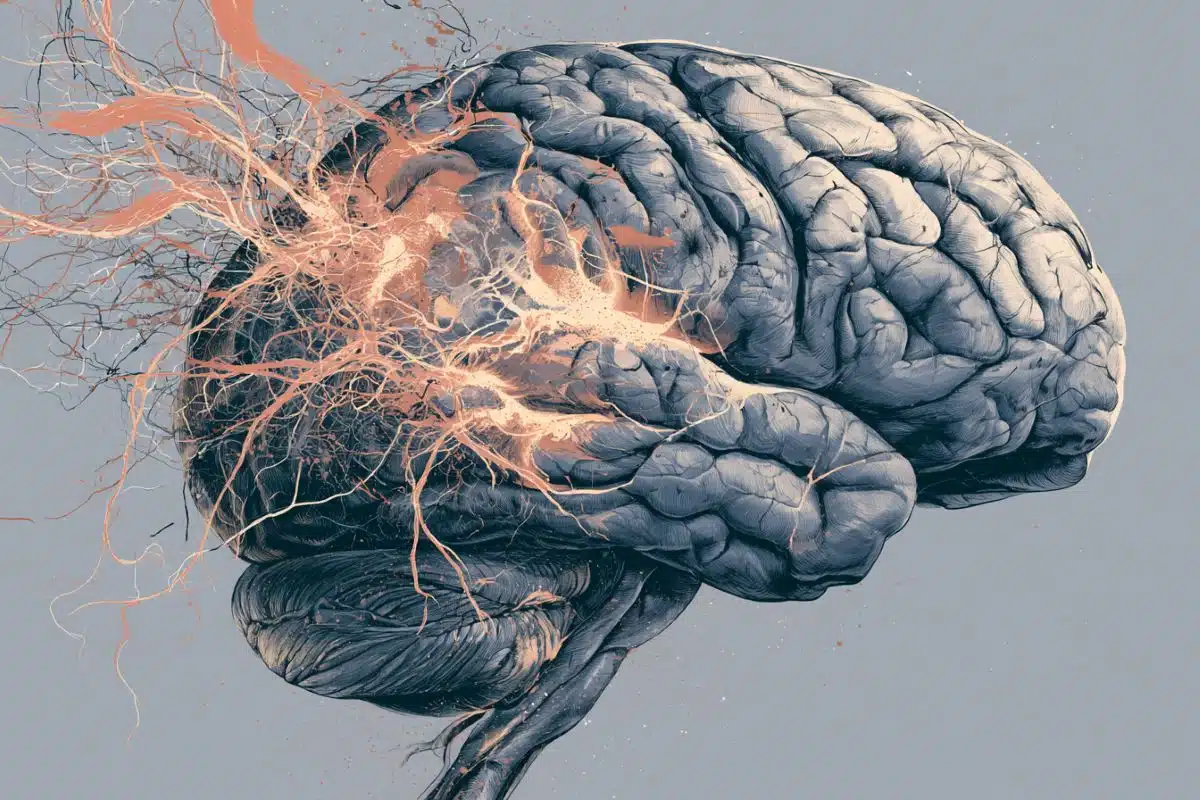
Summary: A high-resolution neuro-imaging study demonstrated that the human brain and Large Language Models (LLMs) organize and predict language using deeply parallel information processing principles. By combining continuous audiobook listening with millisecond-scale EEG and MEG tracking, researchers proved that the human brain fires preemptively to anticipate upcoming words, displaying quieted activity for predictable words and robust neural spikes for unexpected vocabulary.
The data reveals that despite using vastly different physical mediums, biological brains and digital AI systems converge on matching structural strategies to represent language internally, opening new horizons for brain-computer interfaces and diagnostic therapies.
Key Facts
- Predictive Brain Confirmed: High-density M/EEG tracking proved that the human brain actively fires and pre-processes language milliseconds before an expected word physically begins.
- Inverse Signal Intensity: Neural response amplitudes scale inversely with predictive probability; highly anticipated words require less biological processing energy, whereas unexpected words trigger robust neural spikes.
- Structural Convergence: The study suggests that despite different physical mediums (chemical/electrical synapses vs. digital silicon algorithms), both systems construct highly parallel internal structural maps to organize language.
- Audiobook Paradigms: Rather than testing isolated, artificial sentences, researchers captured natural linguistic processing by tracking brainwaves during continuous audiobook narrative consumption.
- Clinical Horizon: Mapping this precise predictive overlap provides future frameworks for diagnosing cognitive processing deficits, constructing high-fidelity brain-computer interfaces, and refining personalized speech therapies.
Source: FAU
Are humans born with innate grammatical scaffolding, or does language develop on the basis of use and experience?
This is a question that is still debated by the various linguistic schools of thought. Recently, powerful AI language models (Large Language Models, LLMs), which process language by predicting subsequent words, have fueled this debate.
“In our study, we combined the natural, continuous language of an audio book with simultaneous electroencephalography and magnetoencephalography measurements and compared the brain activity of the participants directly with the predictive probabilities of large language models, using a temporal resolution of mere milliseconds,” explains Dr. Patrick Krauss.
Are the brain’s predictions measurable?
The measurements indicate that the brain becomes active before the word actually starts. The neural reaction was less pronounced the higher the probability of a word occurring in the relevant context. In contrast, unexpected words triggered stronger neural responses. “This allowed us to prove that the brain actively predicts language. These predictions can be measured and follow similar patterns to modern language models,” explains Dr. Patrick Krauss.
Language models are based on artificial neural networks. They are mathematical information processing units with an architecture based on the human brain. While biological nervous systems work with electrical or chemical signals, language models, or rather their algorithms, calculate numerical values.
“We were particularly surprised that the brain and language models not only show similar predictions. It is also appearing increasingly likely that both systems organize language internally in a comparable way,” says Patrick Krauss.
Do our brains and AI work on similar principles?
The results of the study corroborate key assumptions in cognitive neuroscience and, at the same time, deliver an explanation why AI language models are so effective in a number of applications.
“The fact that the brain and language models come to similar results does not automatically mean that they work in the same way. However, it may suggest that they follow similar information processing principles,” emphasizes Achim Schilling. “The exciting question is why two so different systems share such identical ways of organizing language – and where the boundaries of this convergence lie,” adds Dr. Patrick Krauss.
What is next in the pipeline?
As a next step, the research team would like to find out whether the principles they have discovered are robust and whether they can be transferred to specific applications. “Once we have a better understanding of how the brain and language models represent and predict language, this may in the long term lead to new approaches for diagnosis, personalized therapies, brain-computer interfaces or more transparent AI.”
Key Questions Answered:
A: The research team combined two highly sensitive neuro-imaging technologies: electroencephalography (EEG) and magnetoencephalography (MEG): to achieve a temporal resolution tracking at individual milliseconds. By playing a continuous audiobook, they allowed participants to process language naturally. The M/EEG sensors captured immediate electrical currents and magnetic shifts inside the skull. The data showed distinct neural shifts occurring before a word officially began, providing physical proof that the brain runs a continuous, predictive text algorithm in real-time.
A: When language flows exactly as expected, the brain’s neural response is highly efficient and less pronounced because the incoming stimulus matches the pre-calculated internal model. However, when an unexpected word occurs, it disrupts this feedforward stream. The brain reacts by generating a significantly stronger, more robust neural response spike. This elevated wave represents an active error-correction mechanism, forcing the biological network to rapidly expend energy to rewrite its context map and absorb the unexpected semantic input.
A: No, identical processing results do not automatically mean the underlying mechanical hardware operates in the same way. The human brain runs on complex electrochemical signaling, biological neurotransmitters, and a highly plastic cellular network, while LLMs operate entirely on silicon chips running mathematical probability matrices and vector weights. However, the study strongly implies that both systems obey identical core mathematical laws of information processing, arriving at the exact same systemic solutions for organizing, mapping, and utilizing human language.
Editorial Notes:
- This article was edited by a Neuroscience News editor.
- Journal paper reviewed in full.
- Additional context added by our staff.
About this language and AI research news
Author: Doha El Ezzi
Source: FAU
Contact: Doha El Ezzi – FAU
Image: The image is credited to Neuroscience News
Original Research: Open access.
“The predictive brain: Neural correlates of word expectancy align with large language model prediction probabilities” by Kölbl N, Tziridis K, Maier A, Kinfe T, Chavarriaga R, Schilling A, Krauss P. NeuroImage
DOI:10.1016/j.neuroimage.2026.121966
Abstract
The predictive brain: Neural correlates of word expectancy align with large language model prediction probabilities
Predictive coding theory suggests that the brain continuously anticipates upcoming words to optimize language processing, but the neural mechanisms remain unclear, particularly in naturalistic speech.
Here, we simultaneously recorded EEG and MEG data from 29 participants while they listened to an audio book and assigned predictability scores to nouns using three LLMs: one BERT model and two multilingual LLaMA models.
Our results show that higher predictability is associated with reduced neural responses during word recognition, as reflected in lower N400 amplitudes, and with increased anticipatory activity before word onset. EEG data revealed increased pre-activation in left fronto-temporal regions, while MEG showed a tendency for greater sensorimotor engagement in response to low-predictability words, suggesting a possible motor-related component to linguistic anticipation.
These findings provide new evidence that the brain dynamically integrates top-down predictions with bottom-up sensory input to facilitate language comprehension. To our knowledge, this is the first study to demonstrate these effects using naturalistic speech stimuli, bridging computational language models with neurophysiological data.
Our findings provide novel insights for cognitive computational neuroscience, advancing the understanding of predictive processing in language and inspiring the development of neuroscience-inspired AI.