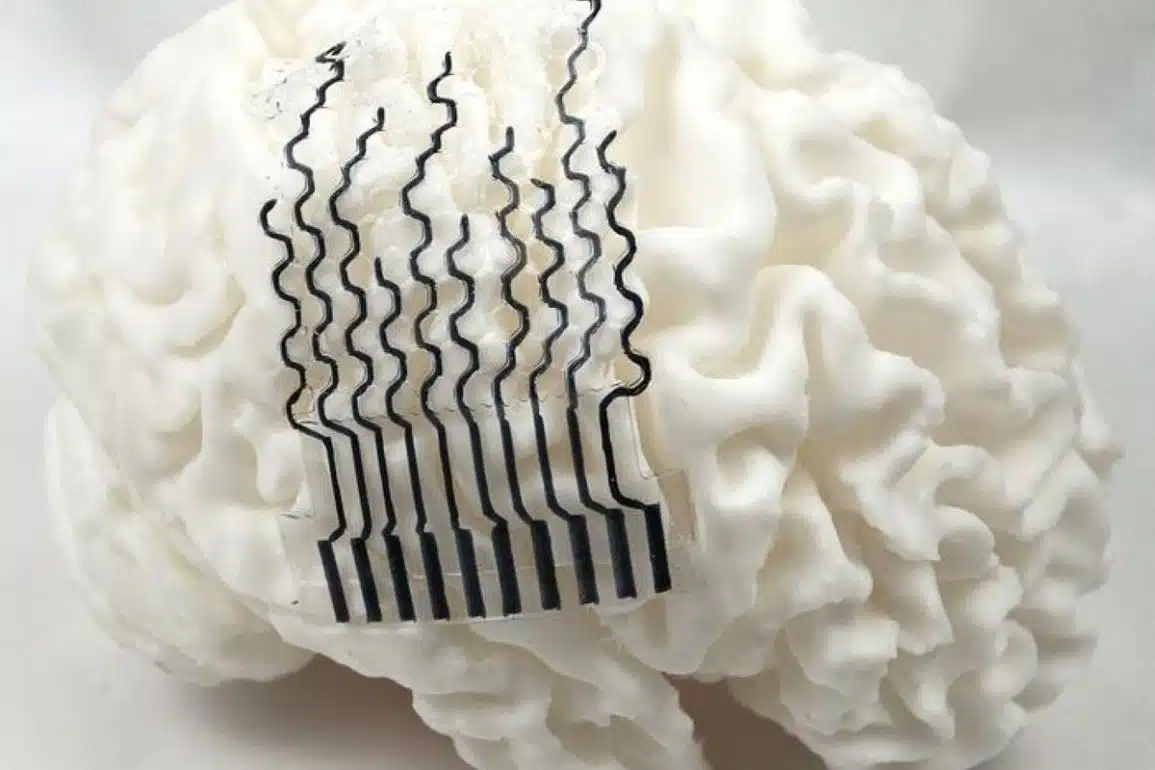
Summary: Researchers created a form of artificial vision for a blind woman with the aid of a brain implant position in the visual cortex. The results pave the way for the creation of visual brain prosthetics to help the blind to regain sight.
Source: KNAW
Newly published research details how a team of scientists from the University Miguel Hernández (Spain), the Netherlands Institute of Neuroscience (Netherlands) and the John A. Moran Eye Center at the University of Utah (USA) successfully created a form of artificial vision for a blind woman using a brain implant.
In the article, “Visual percepts evoked with an Intracortical 96-channel Microelectrode Array inserted in human occipital cortex”, published in The Journal of Clinical Investigation, Eduardo Fernández, MD, PhD, from the University Miguel Hernández details how an array of penetrating electrodes produced a simple form of vision for a 58-year-old blind volunteer.
The team conducted a series of experiments with the blind volunteer in their laboratory in Elche, Spain. The results represent a leap forward for scientists hoping to create a visual brain prosthesis to increase independence of the blind.
Phosphenes
A neurosurgeon implanted a microelectrode array composed of 100 microneedles into the visual cortex of the blind woman to both record from and stimulate neurons located close to the electrodes.
She wore eyeglasses equipped with a miniature video camera; specialized software encoded the visual data collected by the camera and sent it to electrodes located in the brain.
The array then stimulated the surrounding neurons to produce white points of light known as ‘phosphenes’ to create an image.
The blind woman was a former science teacher and had been completely blind for 16 years at the time of the study. She had no complications from the surgery, and researchers determined that the implant did not impair or negatively affect brain function. With the help of the implant, she was able to identify lines, shapes and simple letters evoked by different patterns of stimulation.
To assist her in practicing with the prosthesis, researchers created a video game with a character from the popular television show The Simpsons. Due to her extensive involvement and insight, she is also co-author on the article.
“These results are very exciting because they demonstrate both safety and efficacy and could help to achieve a long-held dream of many scientists, which is the transfer information from the outside world directly to the visual cortex of blind individuals, thereby restoring a rudimentary form of sight,” said Prof. Eduardo Fernández.

He also added that “although these preliminary results are very encouraging, we should be aware that there are still a number of important unanswered questions and that many problems have to be solved before a cortical visual prosthesis can be considered a viable clinical therapy.”
“This new study provides proof-of-principle and demonstrate that our previous findings in monkey experiments can be translated to humans,” said Prof. P. Roelfsema, a co-author on the study. “This work is likely to become a milestone for the development of new technologies that could transform the treatment of blindness”.
“One goal of this research is to give a blind person more mobility,” said Prof. R. A. Normann, also a co-author on the study. “It could allow them to identify a person, doorways, or cars. It could increase independence and safety. That’s what we’re working toward.”
The research team hopes that the next set of experiments will use a more sophisticated image encoder system, capable of stimulating more electrodes simultaneously and to elicit more complex visual images.
About this visual neuroscience and neurotech research news
Author: Esmeralda Schemmekes
Source: KNAW
Contact: Esmeralda Schemmekes – KNAW
Image: The image is in the public domain
Original Research: Closed access.
“Visual percepts evoked with an Intracortical 96-channel microelectrode array inserted in human occipital cortex” by Eduardo Fernández et al. Journal of Clinical Investigation
Abstract
Visual percepts evoked with an Intracortical 96-channel microelectrode array inserted in human occipital cortex
BACKGROUND. A long-held dream of scientists is to transfer information directly to the visual cortex of blind individuals, thereby restoring a rudimentary form of sight. However, no clinically available cortical visual prosthesis yet exists.
METHODS.We implanted an intracortical microelectrode array consisting of 96 electrodes in the visual cortex of a 57-year-old person with complete blindness for a six- month period. We measured thresholds and the characteristics of the visual percepts elicited by intracortical microstimulation.
RESULTS. Implantation and subsequent explantation of intracortical microelectrodes were carried out without complications. The mean stimulation threshold for single electrodes was 66.8 ± 36.5 μA. We consistently obtained high-quality recordings from visually deprived neurons and the stimulation parameters remained stable over time. Simultaneous stimulation via multiple electrodes were associated with a significant reduction in thresholds (p<0.001, ANOVA test) and evoked discriminable phosphene percepts, allowing the blind participant to identify some letters and recognize object boundaries. Furthermore, we observed a learning process that helped the subject to recognize complex patterns over time.
CONCLUSIONS. Our results demonstrate the safety and efficacy of chronic intracortical microstimulation via a large number of electrodes in human visual cortex, showing its high potential for restoring functional vision in the blind.
TRIAL REGISTRATION. ClinicalTrials.gov identifier NCT02983370.
FUNDING. Funding was provided by grant RTI2018-098969-B-100 from the Spanish Ministerio de Ciencia Innovación y Universidades, by grant PROMETEO/2019/119 from the Generalitat Valenciana (Spain), by the Bidons Egara Research Chair of the University Miguel Hernández (Spain) and by the John Moran Eye Center of the University of Utah (US).