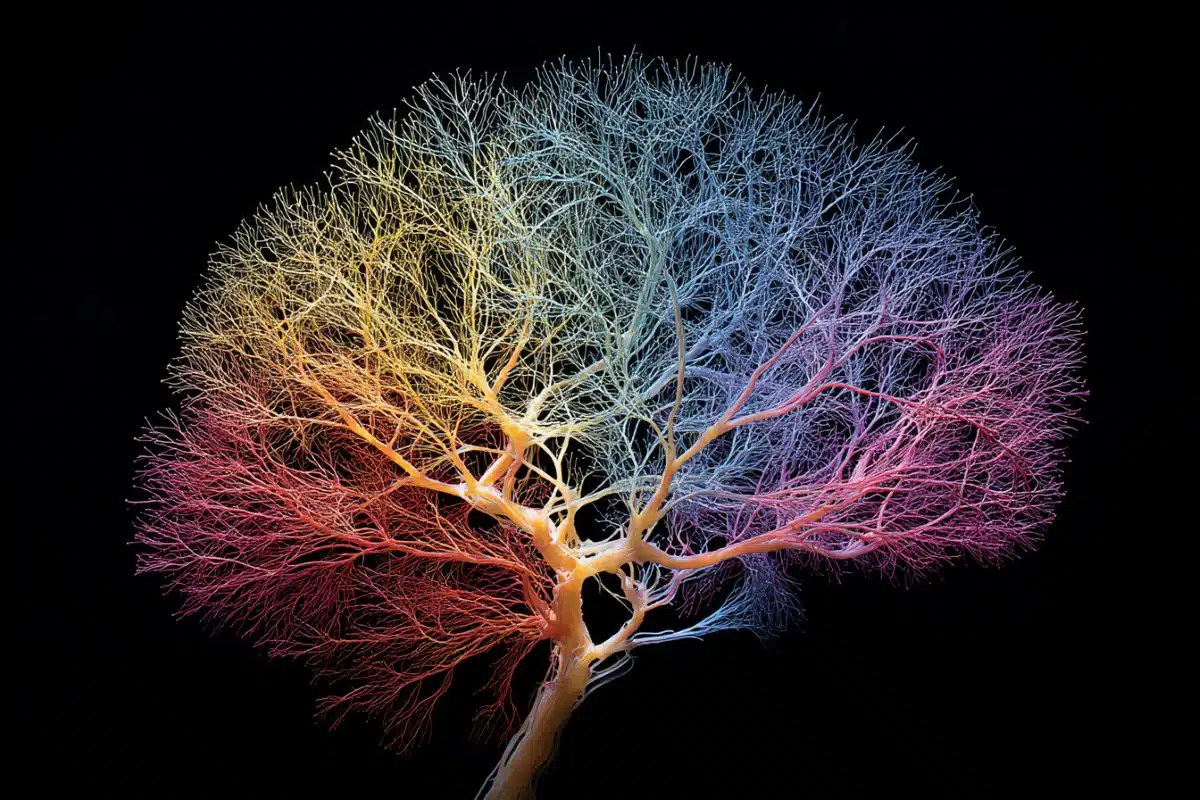
Summary: A biologically grounded computational model built to mimic real neural circuits, not trained on animal data, learned a visual categorization task just as actual lab animals do, matching their accuracy, variability, and underlying neural rhythms. By integrating fine-scale synaptic rules with large-scale architecture across cortex, striatum, brainstem, and acetylcholine-modulated systems, the model reproduced hallmark patterns of learning, including strengthened beta-band synchrony between regions during correct decisions.
It also revealed a set of “incongruent neurons” that predicted errors, a signal researchers only recognized in their animal data after the model exposed it. This biomimetic platform provides a powerful blueprint for exploring disease-related circuit changes and testing therapeutic interventions in silico, offering a new path for developing next-generation neurotherapeutics.
Key Facts
- Biology-First Design: The model embeds real neuronal connectivity rules, neurotransmitter dynamics, and multi-region architecture to replicate biological computation.
- Emergent Realism: It produced learning behavior, beta synchrony, and decision patterns that matched lab animals—even without being trained on biological datasets.
- Hidden Signals Exposed: The discovery of “incongruent neurons” reveals overlooked error-predictive activity present in real brains.
Source: Picower Institute at MIT
A new computational model of the brain based closely on its biology and physiology not only learned a simple visual category learning task exactly as well as lab animals, but even enabled the discovery of counterintuitive activity by a group of neurons that researchers working with animals to perform the same task had not noticed in their data before, said a team of scientists at Dartmouth College, MIT, and the State University of New York at Stony Brook.
Notably, the model produced these achievements without ever being trained on any data from animal experiments. Instead, it was built from scratch to faithfully represent how neurons connect into circuits and then communicate electrically and chemically across broader brain regions to produce cognition and behavior.
Then, when the research team asked the model to perform the same task that they had previously performed with the animals (looking at patterns of dots and deciding which of two broader categories they fit), it produced highly similar neural activity and behavioral results, acquiring the skill with almost exactly the same erratic progress.
“It’s just producing new simulated plots of brain activity that then only afterward are being compared to the lab animals. The fact that they match up as strikingly as they do is kind of shocking,” said Richard Granger, a professor of Psychological and Brain Sciences at Dartmouth and senior author of a new study in Nature Communications that describes the model.
A goal in making the model, and newer iterations developed since the paper was written, is not only to offer insight into how the brain works, but also how it might work differently in disease and what interventions could correct those aberrations, added co-author Earl K. Miller, Picower Professor in The Picower Institute for Learning and Memory at MIT.
Miller, Granger, and other members of the research team have founded the company Neuroblox.ai to develop the models’ biotech applications. Co-author Lilianne R. Mujica-Parodi, a biomedical engineering professor at Stony Brook who is Lead Principal Investigator for the Neuroblox Project, is CEO of the company.
“The idea is to make a platform for biomimetic modeling of the brain so you can have a more efficient way of discovering, developing and improving neurotherapeutics. Drug development and efficacy testing, for example, can happen earlier in the process, on our platform, before the risk and expense of clinical trials.” said Miller, who is also a faculty member of MIT’s Brain and Cognitive Sciences department.
Making a biomimetic model
Dartmouth postdoc Anand Pathak created the model, which differs from many others in that it incorporates both small details, such as how individual pairs of neurons connect with each other, and large-scale architecture, including how information processing across regions is affected by neuromodulatory chemicals such as acetylcholine.
Pathak and the team iterated their designs to ensure they obeyed various constraints observed in real brains, such as how neurons become synchronized by broader rhythms. Many other models focus only on the small or big scales but not both, he said.
“We didn’t want to lose the tree, and we didn’t want to lose the forest,” Pathak said.
The metaphorical “trees,” called “primitives” in the study, are small circuits of a few neurons each that connect based on electrical and chemical principles of real cells to perform fundamental computational functions.
For example, within the model’s version of the brain’s cortex, one primitive design has excitatory neurons that receive input from the visual system via synapse connections affected by the neurotransmitter glutamate.
Those excitatory neurons then densely connect with inhibitory neurons in a competition to signal them to shut down the other excitatory neurons—a “winner takes all” architecture found in real brains that regulates information processing.
At a larger scale, the model encompasses four brain regions needed for basic learning and memory tasks: a cortex, a brainstem, a striatum and a “tonically active neuron” (TAN) structure that can inject a little “noise” into the system via bursts of aceytlcholine.
For instance, as the model engaged in the task of categorizing the presented patterns of dots, the TAN at first ensured some variability in how the model acted on the visual input so that the model could learn by exploring varied actions and their outcomes.
As the model continued to learn, cortex and striatum circuits strengthened connections that suppressed the TAN, enabling the model to act on what it was learning with increasing consistency.
As the model engaged in the learning task, real-world properties emerged including a dynamic that Miller has commonly observed in his research with animals. As learning progressed, the cortex and striatum became more synchronized in the “beta” frequency band of brain rhythms, and this increased synchrony correlated with times when the model (and the animals) made the correct category judgement about what they were seeing.
Revealing ‘incongruent’ neurons
But the model also presented the researchers with a group of neurons—about 20 percent—whose activity appeared highly predictive of error. When these so-called “incongruent” neurons influenced circuits, the model would make the wrong category judgement. At first, Granger said, the team figured it was a quirk of the model. But then they looked at the real-brain data Miller’s lab accumulated when animals performed the same task.
“Only then did we go back to the data we already had, sure that this couldn’t be in there because somebody would have said something about it, but it was in there and it just had never been noticed or analyzed,” he said.
Miller said these counterintuitive cells might serve a purpose: It’s all well and good to learn the rules of a task but what if the rules change? Trying out alternatives from time to time can enable a brain to stumble upon a newly emerging set of conditions. Indeed, a separate Picower Institute lab recently published evidence that humans and other animals do this sometimes.
While the model described in the new paper performed beyond the team’s expectations, Granger said, the team has been expanding it to make it sophisticated enough to handle a greater variety of tasks and circumstances. For instance, they have added more regions and new neuromodulatory chemicals. They’ve also begun to test how interventions such as drugs affect its dynamics.
In addition to Granger, Miller, Pathak and Mujica-Parodi, the paper’s other authors are Scott Brincat, Haris Organtzidis, Helmut Strey, and Evan Antzoulatos.
Funding: The Baszucki Brain Research Fund, United States, the Office of Naval Research, and the Freedom Together Foundation provided support for the research.
Key Questions Answered:
A: It learned the visual category task with nearly identical patterns of progress, neural activity, and learning dynamics—even without training on biological data.
A: It revealed a population of “incongruent neurons” that predicted errors. When researchers checked old animal data, the same pattern was present but had gone unnoticed.
A: It offers a platform for probing brain computation, simulating disease states, and testing neurotherapeutics before moving to risky and expensive trials.
Editorial Notes:
- This article was edited by a Neuroscience News editor.
- Journal paper reviewed in full.
- Additional context added by our staff.
About this AI, learning, and neuroscience research news
Author: David Orenstein
Source: Picower Institute at MIT
Contact: David Orenstein – Picower Institute at MIT
Image: The image is credited to Neuroscience News
Original Research: Open access.
“Biomimetic model of corticostriatal micro-assemblies discovers a neural code” by Richard Granger et al. Nature Communications
Abstract
Biomimetic model of corticostriatal micro-assemblies discovers a neural code
Although computational models have deepened our understanding of neuroscience, it is still highly challenging to link actual low-level physiological activity (spiking, field potentials) and biochemistry (transmitters and receptors) directly with high-level cognitive abilities (decision-making, working memory) and associated disorders.
Here, we introduce a mechanistically accurate multi-scale model directly generating simulated physiology from which extended neural and cognitive phenomena emerge.
The model produces spiking, fields, phase synchronies, and synaptic change, directly generating working memory, decisions, and categorization.
These were then validated on extensive experimental macaque data from which the model received no prior training of any kind. Moreover, the simulation uncovered a previously unknown neural code (“incongruent neurons”) that specifically predicts upcoming erroneous behaviors, also subsequently confirmed in empirical data.
The biomimetic model thus directly and predictively links decision and reinforcement signals, of computational interest, with spiking and field codes, of neurobiological importance.