Robots enhance mobility for visually and physically impaired, improve treatment for atrial fibrillation.
Three projects have been awarded funding by the National Institutes of Health to develop innovative robots that work cooperatively with people and adapt to changing environments to improve human capabilities and enhance medical procedures. Funding for these projects totals approximately $2.4 million over the next five years, subject to the availability of funds.
The awards mark the second year of NIH’s participation in the National Robotics Initiative (NRI), a commitment among multiple federal agencies to support the development of a new generation of robots that work cooperatively with people, known as co-robots.
“These projects have the potential to transform common medical aids into sophisticated robotic devices that enhance mobility for individuals with visual and physical impairments in ways only dreamed of before,” said NIH Director Francis S. Collins, M.D., Ph.D. “In addition, as we continue to rely on robots to carry out complex medical procedures, it will become increasingly important for these robots to be able to sense and react to changing and unpredictable environments within the body. By supporting projects that develop these capabilities, we hope to increase the accuracy and safety of current and future medical robots.”

NIH is participating in the NRI with the National Science Foundation, the National Aeronautics and Space Administration, and the U.S. Department of Agriculture. NIH has funded three projects to help develop co-robots that can assist researchers, patients, and clinicians.
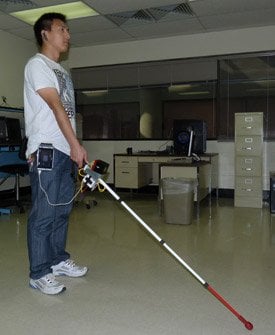
- A Co-Robotic Navigation Aid for the Visually Impaired: The goal is to develop a co-robotic cane for the visually impaired that has enhanced navigation capabilities and that can relay critical information about the environment to its user. Using computer vision, the proposed cane will be able to recognize indoor structures such as stairways and doors, as well as detect potential obstacles. Using an intuitive human-device interaction mechanism, the cane will then convey the appropriate travel direction to the user. In addition to increasing mobility for the visually impaired and thus quality of life, methods developed in the creation of this technology could lead to general improvements in the autonomy of small robots and portable robotics that have many applications in military surveillance, law enforcement, and search and rescue efforts. Cang Ye, Ph.D., University of Arkansas at Little Rock (co-funded by the National Institute of Biomedical Imaging and Bioengineering [NIBIB] and the National Eye Institute).

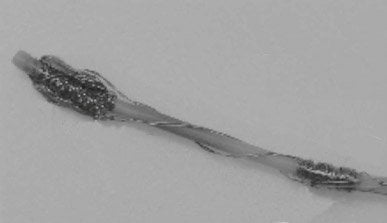
- MRI-Guided Co-Robotic Active Catheter: Atrial fibrillation is an irregular heartbeat that can increase the risk of stroke and heart disease. By purposefully ablating (destroying) specific areas of the heart in a controlled fashion, the propagation of irregular heart activity can be prevented. This is generally achieved by threading a catheter with an electrode at its tip through a vein in the groin until it reaches the patient’s heart. However, the constant movement of the heart as well as unpredictable changes in blood flow can make it difficult to maintain consistent contact with the heart during the ablation procedure, occasionally resulting in too large or too small of a lesion. The aim is to develop a co-robotic catheter that uses novel robotic planning strategies to compensate for physiological movements of the heart and blood and that can be used while a patient undergoes MRI — an imaging method used to take pictures of soft tissues in the body such as the heart. By combining state-of-the art robotics with high-resolution, real-time imaging, the co-robotic catheter could significantly increase the accuracy and repeatability of atrial fibrillation ablation procedures. M. Cenk Cavusoglu, Ph.D., Case Western Reserve University, Cleveland (funded by NIBIB).

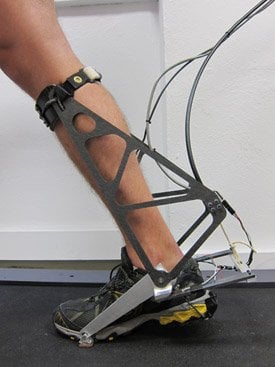
These projects are supported by the grants EB018117-01; EB018108-01; NR014756-01; from the National Institute of Biomedical Imaging and Bioengineering (NIBIB), the National Eye Institute (NEI), and the National Institute of Nursing Research (NINR) and by award #1355716 from the National Science Foundation.
A program announcement, soliciting for NRI applications for fiscal year 2014, has recently been published.
In 2014, the participating NIH institutes are interested in targeting this solicitation to support the development of assistive robotic technology to achieve functional independence in humans; improve quality of life; assist with behavioral therapy and personalized care; and promote wellness/health.
Notes about this robotics research
Contact: Margot Kern – NIH
Source: NIH press release
Image Source: The co-robotic cane image is credited to Cang Ye, Ph.D., University of Arkansas at Little Rock. The co-robotic catheter image is credited to Mark Griswold, Ph.D., and Natalia Gudino, Ph.D., Case Western Reserve University. The ankle interface image is credited to Steven Collins, Ph.D., Carnegie Mellon University. All images are adapted from the NIH press release
#robotics, #technology, #science