

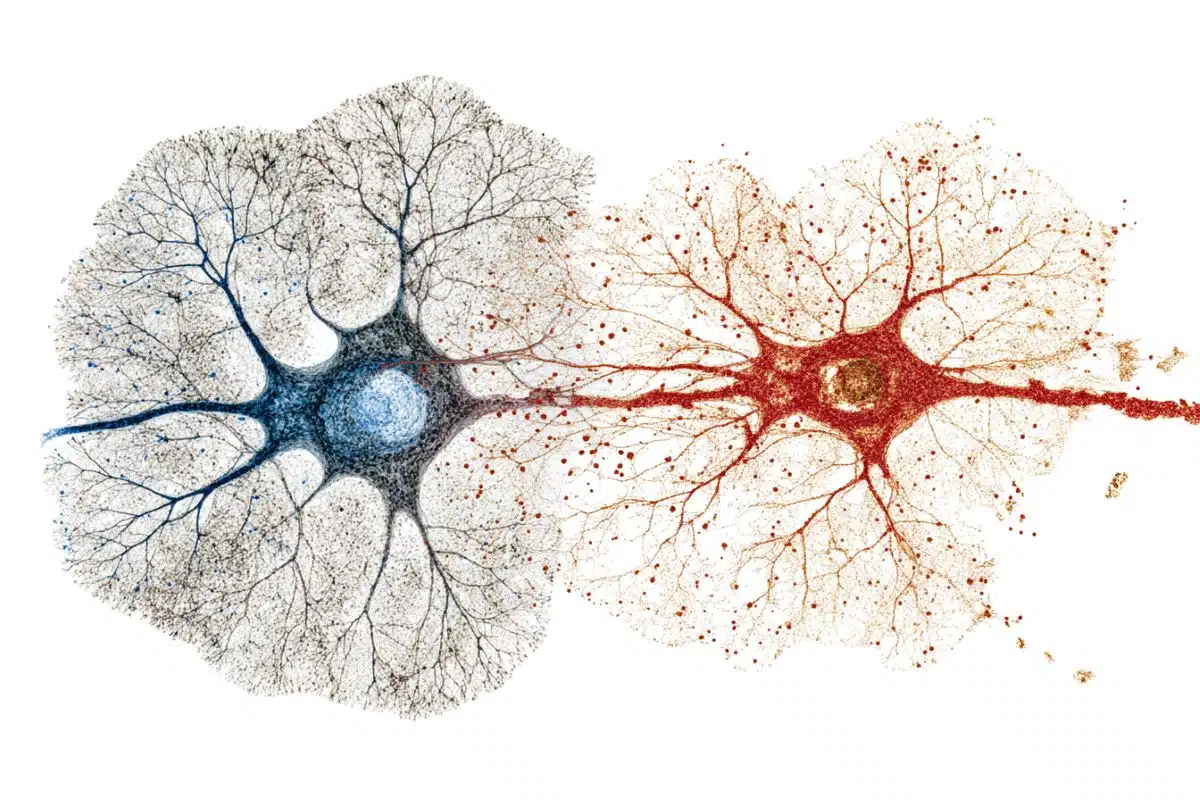
Summary: A comparative neurodevelopmental study identified the cellular timing mechanism that dictates the distinct structural proportions of the mammalian cerebral cortex. The research demonstrates that variations in cortical layer thickness among different species are driven by the specific “aging rates” of neural progenitor cells during early embryonic development.
By comparing the brains of evolutionary neighbors—rats and mice—investigators discovered that prolonged expression of molecules in the Wnt signaling pathway delays a critical cellular production switch, generating an unusually high volume of deep-layer neurons in rats and offering new insights into mammalian brain evolution and regenerative medicine.
Key Facts
- The Cortical Architecture Blueprint: The outer regions of the mammalian brain, the cortex, feature a highly ordered, layered distribution of specialized neurons that remains remarkably consistent from small mice to massive elephants. However, the exact proportions of these cell layers vary drastically from species to species.
- The Rat Discrepancy: Investigators initiated their study by evaluating the rat cortex, discovering that rats possess a significantly larger deep layer relative to their upper cortical layer compared to seven other surveyed mammals, including mice.
- Cellular Count Over Area: A detailed microscopic audit between closely related mice and rats revealed that the rat’s expanded deep cortical layer is explicitly caused by an absolute abundance of deep-layer neurons rather than an expansion of the physical layer area.
- The Delayed Progenitor Switch: Tracking embryonic stem cells using an advanced cell-labeling technique revealed distinct production windows. While mouse neural progenitor cells only manufacture deep-layer neurons for one to two days before permanently switching to upper-layer production, rat progenitor cells continue creating deep-layer neurons for roughly four days before making the transition.
- Wnt Signaling Cadence: This extended developmental window is regulated by Wnt signaling—a vital molecular pathway that dictates the pacing of cortical development. Embryonic rat brains exhibit prolonged expression of Wnt signaling genes, effectively slowing down the “aging rate” of progenitor cells to prolong deep-layer neuron production.
- Translational Medical Horizon: Senior author Ikuo Suzuki notes that unmasking how related species develop divergent brain structures advances the baseline understanding of human brain evolution. These evolutionary insights provide critical data to decode the root mechanics of human developmental and neurological disorders, with promising future applications in regenerative tissue medicine.
Source: Osaka University
The outer regions of the brain, the cortex, have specific layers of different cells – neurons – that are similarly ordered among all mammals, from tiny mouse brains to huge elephant brains. However, the proportions of different cell layers vary widely among species, and little is known about how and why this variation happens.
Now, researchers from The University of Osaka have suggested, following intense research on developing brain cells, that these differences are related to the timing of specific signals in the brain during early development. These findings have been published in The EMBO Journal.
The research team began their investigation by focusing specifically on the rat cortex, noting that rats had a much larger deep layer – relative to the upper cortical layer – than seven other mammals, including mice.
Following this initial discovery the brains of rats were compared with those of mice – their closest evolutionary relative – in more detail. The research subsequently reported that this difference was due to the greater numbers of deep layer neurons present, rather than just a larger layer area.
“We next wanted to see how this difference in the number of deep layer neuron arises,” says Yuki Yamauchi, lead author of the study. “Using a cell-labeling technique in rats and mice, we saw that rat neural progenitor cells produced more deep layer neurons.”
A neural progenitor cell is a type of stem cell that generates neurons while the brain is still developing. To understand why rat brains create more deep layer neurons in early development, the timing of upper and deep layer neuron production in mice and rats was assessed.
Interestingly, mice produced deep layer neurons for one or two days before the progenitor cells switched to producing upper layer neurons, whereas rats produced deep layer neurons for around four days before making this switch.
This difference between rats and mice is likely caused by different timing of the expression of molecules involved in Wnt signaling, a process that is already known to be important for regulating the timing of cortical development. Wnt glycoproteins are key for enacting various cell processes, and rats had prolonged expression of Wnt signaling genes, leading to extended deep layer neuron production.
“As well as highlighting the unusual cortical structure of rats relative to other mammals, we demonstrated that this variation arises from the distinct ‘aging rates’ of neural progenitor cells,” notes senior author of the study Ikuo Suzuki. “This finding broadens our understanding of the different mechanisms underlying divergent brain structure among related species.”
These findings from the developing rat cortex will contribute to a deeper understanding of human brain evolution. In turn, this may also help broaden our knowledge of the mechanisms underlying developmental and neurological disorders, with exciting potential applications in regenerative medicine.
Key Questions Answered:
A: It all comes down to a cellular timer. While both animals use the exact same types of stem cells to construct their brains, the neural progenitor cells in rats stay “young” for twice as long as they do in mice. This delay allows the rat brain to pile up a massive abundance of deep-layer neurons before switching over to building the upper layers.
A: The primary coordinator is the Wnt signaling pathway, which regulates the pace of cortical growth. The study from Osaka University found that rats express Wnt signaling genes for an extended period during early development. This prolonged chemical signal keeps the stem cells locked in deep-layer production mode, directly altering the brain’s ultimate physical architecture.
A: Human brains evolved through similar structural shifts in cell layer proportions. By isolating the exact molecular switches and aging rates that control how neurons are created, scientists gain a blueprint for human brain evolution. In the future, this can help researchers identify what goes wrong in developmental brain disorders and unlock new therapies in regenerative medicine to rebuild damaged neural tissue.
Editorial Notes:
- This article was edited by a Neuroscience News editor.
- Journal paper reviewed in full.
- Additional context added by our staff.
About this neurodevelopment research news
Author: Saori Obayashi
Source: University of Osaka
Contact: Saori Obayashi – University of Osaka
Image: The image is credited to Neuroscience News
Original Research: Open access.
“Interspecific diversity in the neuronal composition of the mammalian cortex arises from heterochrony in neurogenesis” by Yuki Y Yamauchi, Xuanhao D Sheu, Rafat Tarfder, Takuma Kumamoto, Jun Hatakeyama, Haruka Sato, Pauline Rouillard, Merve Bilgic, Shuto Deguchi, Tomonori Nakamura, Yusuke Kishi, Kazuo Emoto & Ikuo K Suzuki. EMBO Journal
DOI:10.1038/s44318-026-00806-z
Abstract
Interspecific diversity in the neuronal composition of the mammalian cortex arises from heterochrony in neurogenesis
Mammals share a laminar cerebral cortex, with excitatory neuron subtypes organized in distinct layers. Although this framework is conserved, subtype balance varies markedly between species due to largely unknown mechanisms.
Here, we show that species-specific neuronal composition arises from non-uniform scaling of the temporal dynamics of neurogenesis. Comparative histology of eight mammalian species reveals a significant, rat-specific expansion of the deep layer in the somatosensory cortex.
This feature of the rat cortex results from a specific extension of the early neurogenetic phase of deep-layer neuron production before transitioning to the upper layer, as confirmed by neuronal birthdating and single-cell transcriptomics. The duration of deep-layer neuron production is regulated by a genetic program controlling neural progenitor cell aging, including canonical Wnt signaling.
Comparative single-cell transcriptomics revealed that cortical progenitor cells in rats exhibit significantly elevated Wnt ligand expression. Therefore, while sequential cortical neurogenesis is conserved, its progression is non-uniformly scaled between species.
Precise heterochronic fine-tuning allows evolutionary refinement of cellular configuration without drastic remodeling of the conserved corticogenesis program.


