

Summary: A new study revealed how social insect colonies survive the violent, chaotic aftermath of losing their queen. The research focuses on tropical paper wasps (Polistes canadensis), showing that queen removal triggers immediate social breakdown and aggressive civil warfare as workers fight for reproductive dominance.
However, instead of collapsing, the colony’s structural integrity is saved by a distinct group of peaceful wasps dubbed “compensators”. These individuals completely bypass the conflict, strategically shifting their energy to ramp up essential foraging and brood care to keep the society functional during political turmoil.
Key Facts
- The Tropical Dynamic: Unlike temperate-zone wasps with highly ordered hierarchies and predictable rules of succession, tropical paper wasp colonies operate in a much more volatile system where any female worker retains the biological capacity to breed and claim the throne if a power vacuum arises.
- Immediate Social Turmoil: Experimentally removing queens from established colonies in Panama triggered an immediate, intense escalation of physical aggression. Normal cooperative social networks rapidly dissolved as multiple high-tier workers violently competed for reproductive dominance.
- The Rise of the Compensators: Despite widespread structural chaos, the societies survived. The stabilization was driven entirely by “compensators”, individual wasps that consciously avoided the political fighting and instead heavily increased their work ethic to feed and care for the developing brood.
- Strategic Choices Over Biological Roles: Compensators showed no distinct biological differences from the wasps engaging in the civil warfare. This indicates that their behavior reflects a dynamic, strategic choice: some individuals gamble on fighting for direct future reproduction, while others focus on protecting the survival of the current brood, who are typically their own siblings.
- Historical Data Re-Analysis: These new insights were unearthed using an innovative, modern re-analysis of highly detailed behavioral data originally harvested during early-2000s fieldwork in Panama.
- Challenging Succession Dogma: Senior author Professor Seirian Sumner notes that the study fundamentally challenges the classic evolutionary belief that cooperative animal societies must rely on orderly, rule-based systems to remain stable, proving that aggression-based succession is fully viable if background workers absorb the societal costs of the conflict.
Source: UCL
When the loss of a queen wasp triggers a power struggle and social turmoil, colonies can survive the upheaval thanks to helpful wasps that pick up the slack, finds a new study led by UCL researchers.
The findings, published in the journal Animal Behaviour, show that even in colonies where leadership succession is violent and chaotic, there are individual wasps that compensate for the upheaval by working harder on essential tasks.
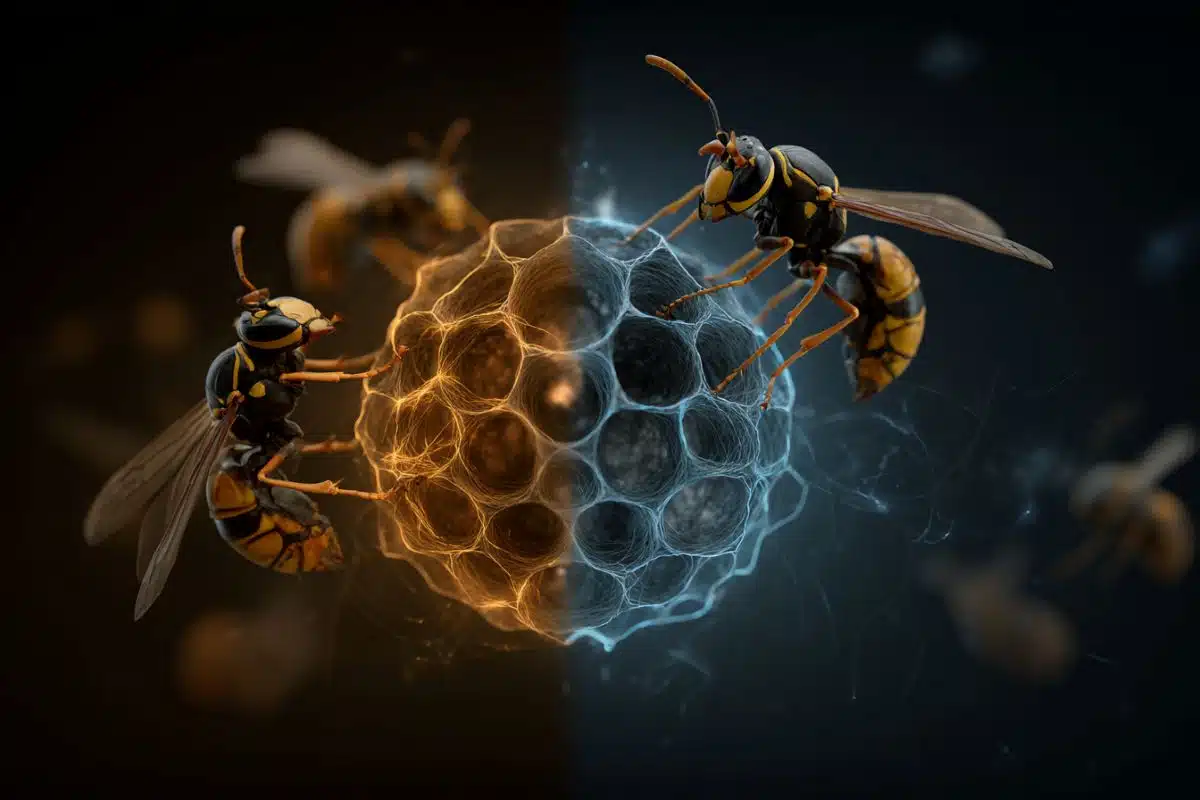
The study focuses on cooperative societies of tropical paper wasps (Polistes canadensis), found in the Caribbean, where many individuals live together but reproduction is controlled by a single dominant female. But the other female workers are not sterile, and could take over as the next breeder if a power vacuum arises.
To understand how colonies respond to leadership loss, UCL researchers experimentally removed queens from established colonies. What followed was immediate disruption.
Aggressive interactions between females escalated as multiple wasps competed for reproductive dominance, and the colony’s usual social networks rapidly broke down. Rather than a smooth transfer of power, succession involved a period of intense conflict involving many group members.
Despite this turmoil, the wasp colonies did not collapse. Instead, stability was maintained by a distinct group of individuals the researchers term “compensators.” These compensators avoided engaging in aggressive conflict and power struggles, and instead increased their investment in essential tasks such as foraging and brood care. By ensuring that food continued to reach developing offspring, they helped maintain societal function through periods of intense social turmoil.
The compensators did not appear to be biologically different from those engaging in fighting, which the researchers say suggests their behaviour may reflect strategic decisions rather than fixed roles. Some wasps may see achieving dominance as their best chance of future reproduction, while others seek to ensure the survival of the brood, typically composed of the workers’ own siblings.
Lead author Dr Owen Corbett (UCL Centre for Biodiversity & Environment Research, UCL Biosciences), who conducted this study as part of his PhD at UCL, said: “The conflict after queen removal was intense, but it wasn’t the whole story.
“While some individuals fought over dominance, others completely avoided the conflict and quietly stepped up to keep the colony running. Cooperation didn’t disappear; it was redistributed.”
The research provides a rare window into a poorly studied form of reproductive succession in tropical cooperative wasps. Most previous studies of cooperative colonies have focused on temperate species such as those found in Europe or North America that have highly ordered dominance hierarchies and predictable succession rules. This study instead examined a more chaotic, aggression-driven system in a group that has received far less attention, broadening understanding of the diverse ways animal societies can resolve leadership conflicts.
These insights come from a fresh analysis of behavioural data collected by some of this study’s research team during fieldwork in the early 2000s in Panama.
The findings challenge the idea that cooperative societies must depend on orderly, rule-based succession systems to remain stable. While aggression-based succession is often assumed to be too costly to persist, the study shows that such systems can be viable when compensators offset the costs of conflict.
Senior author Professor Seirian Sumner (UCL Centre for Biodiversity & Environment Research, UCL Biosciences) said: “Understanding how animal societies manage conflict can help us think differently about cooperation more broadly. In times of turmoil, society depends on those who keep doing the essential work in the background. In many ways, we may be more like wasps than we realise.”
Funding: The research was funded by the Natural Environment Research Council (NERC) and the Smithsonian Institution.
Key Questions Answered:
A: It is a brilliant, calculated evolutionary gamble. The wasps that choose to fight are betting on a high-risk, high-reward strategy to become the sole reproductive leader of the colony. The “compensators,” on the other hand, choose a safer evolutionary bet: by ignoring the war and keeping the nursery alive, they ensure the survival of the developing brood, who are their direct genetic siblings.
A: For decades, scientists assumed that if an animal society relied on violent, rule-free aggression to pick a new leader, the internal costs of that warfare would cause the whole colony to collapse. This study shatters that assumption. It proves that cooperation doesn’t just vanish during a crisis; it gets redistributed. A society can handle intense political warfare as long as there is a quiet class of individuals willing to absorb the damage and keep the infrastructure running.
A: As the researchers point out, we might be a lot more like these wasps than we care to admit. When a major leadership crisis or social upheaval hits a human population, our macro-survival rarely depends on the loud, chaotic power struggles happening at the top. Instead, the preservation of our entire society relies on the quiet, unheralded “compensators” in the background who simply show up every single day to keep doing the essential work.
Editorial Notes:
- This article was edited by a Neuroscience News editor.
- Journal paper reviewed in full.
- Additional context added by our staff.
About this neuroscience and social behavior research news
Author: Sophie Hunter
Source: UCL
Contact: Sophie Hunter – UCL
Image: The image is credited to Neuroscience News
Original Research: Open access.
“Compensation of labour by non-competitive individuals mitigates costs of aggressive succession contest in a tropical social wasp” by Owen R. Corbett, Stephanie Dreier, Thibault Lengronne, Solenn Patalano, Max Reuter, and Seirian Sumner. Animal Behaviour
DOI:10.1016/j.anbehav.2026.123581
Abstract
Compensation of labour by non-competitive individuals mitigates costs of aggressive succession contest in a tropical social wasp
Cooperative breeders rear young through a division of labour among parents and alloparents (helpers), with reproduction monopolized by one or a few individuals despite all group members being potential breeders. This group-living strategy is found across the animal kingdom in vertebrate and invertebrate taxa.
Reproductive succession, in which a previously nonreproductive subordinate female replaces the dominant breeder, is common in these societies and represents a major source of reproductive conflict among group members.
The complex trade-offs associated with these social systems have led to a variety of mechanisms that improve individual fitness by mitigating reproductive conflict and maintaining colony cohesion. Social wasps (Vespidae) include a wide diversity of cooperatively breeding species and are highly tractable models for studying how succession conflicts are resolved, yet most of our understanding of cooperatively breeding wasps is based on a small number of species with highly organized, convention-based dominance and predetermined breeder succession systems.
Here we investigated the putatively aggression-based succession system of a tropical paper wasp cooperative breeder, Polistes canadensis. We characterized the aggressive interactions and provisioning behaviours of queenright postemergence colonies and, through experimental queen loss, assessed changes in these behaviours at the individual and group level throughout the succession process.
We found that social networks broke down, with intense aggressive interactions involving many colony members when the queen was lost. Despite this disruption, provisioning behaviour and affiliative social networks were maintained by previously less-active individuals that switched to foraging roles. Thus, the costs of aggression-based succession were mitigated through compensation by noncompeting group members.
Our findings provide support for the hypothesis that aggression-based reproductive succession can be a stable strategy for cooperative breeders when a compensatory mechanism mitigates fitness costs associated with colony failure.


