

Summary: Researchers have discovered that the fundamental building blocks of the human cortex are themselves uniquely powerful microchips. By utilizing artificial intelligence to measure the computational complexity of single cells, the team proved that a single human cortical neuron is not a simple switch, but an extraordinarily sophisticated computing device with processing capabilities equivalent to an entire multi-layered deep artificial neural network (ANN).
Key Facts
- The “Twin” Imitation Metric: To mathematically define a neuron’s processing power, the team developed a brilliant new framework. They task an advanced artificial neural network with learning and flawlessly reproducing the input/output functions of a single human cortical brain cell. The more computational layers the artificial “twin” requires to mimic the biological cell, the more complex that single neuron is.
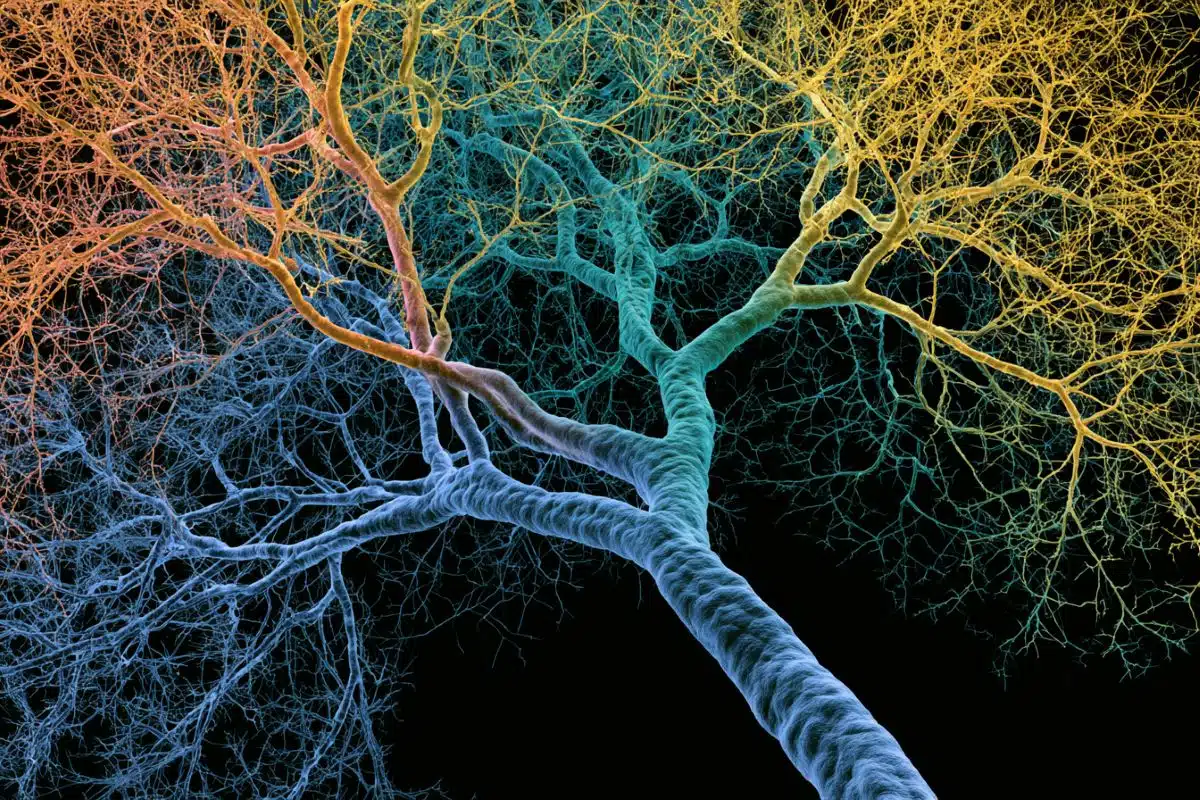
- The Dendritic Tree Advantage: The study revealed that human cortical neurons possess a massive computational advantage over other mammals, driven by their intensely dense, richly branching dendritic trees and highly specialized, unique electrical properties.
- Single-Cell Pattern Recognition: Rather than needing a massive web of thousands of cells to execute basic discrimination tasks, the rich branching structure allows a single human cortical neuron to perform advanced computations independently—such as processing visual inputs to distinguish between completely different complex images (e.g., a cat versus a dog).
- Challenging the Scale Theory: These findings directly challenge the long-standing scientific theory that human intelligence is simply a product of brain size and total cell count. Instead, human evolution prioritized the internal computational depth of the individual building blocks themselves.
- A New Template for Neuromorphic AI: Today’s state-of-the-art machine learning models are built from highly simplified, uniform mathematical points. This study offers a general framework linking physical cell geometry to raw processing power, providing a blueprint for a revolutionary new generation of brain-inspired AI built from artificial units that are themselves inherently deep and multi-layered.
Source: Hebrew University of Jerusalem
What makes the human brain capable of language, imagination, mathematics, and invention?
For many years, the prevailing view was that the secret of human intelligence lay mainly in scale: the sheer number of neurons in the human brain – close to 100 billion – and the vast network of connections among them. But a new study suggests that part of the answer may lie at a much smaller scale: in the extraordinary computational power of individual brain cells.
Researchers have found that neurons in the human cortex are significantly more complex information-processing units (“microchips”) than those of other mammals. The findings suggest that the building blocks of the human cortex may themselves be uniquely powerful, offering a possible explanation for how humans developed such exceptional cognitive abilities.
The study was led by Hebrew University researchers Profs. Idan Segev and Mickey London, together with the PhD students Ido Aizenbud and Daniela Yoeli, at the Edmond and Lily Safra Center for Brain Sciences (ELSC), and in collaboration with Prof. Chris de Kock from the Free University, Amsterdam.
“People often think of a neuron as a simple switch that either turns on or off,” said Segev. “What we show is that a single human neuron is itself an extraordinarily sophisticated computing device.”
To make the discovery, the researchers developed a new way to measure the computational complexity of individual neurons. Using advanced computer models and artificial intelligence, they assessed how difficult it would be for a state-of-the-art artificial neural network (ANN) to learn and reproduce the input/output behavior of a single brain cell.
The harder it is for the “twin” artificial network to imitate the input-to-output function of the neuron, the more computationally powerful that neuron is.
The results show that human cortical neurons have a remarkable computational advantage. Thanks to their richly branching dendritic trees and distinctive electrical properties, these cells can perform surprisingly complex computations on incoming information, such as visual input (e.g., distinguishing between images of cats versus dogs).
This means that a single human cortical neuron is not just a simple “on-off” building block in the brain; it is already a sophisticated computing unit in its own right, with computational capabilities equivalent to those of a deep neural network.
The findings challenge the traditional view that intelligence emerges mainly from the number of neurons and the connections between them. Instead, they suggest that the sophistication of the neurons themselves may have played an important role in the evolution of human cognition.
The study also offers a new systematic and general framework for linking the physical structure of brain cells to their computational abilities, bringing scientists one step closer to understanding how the human brain gives rise to thought, learning, and cognition.
The study may also inspire a new generation of brain-inspired AI, built from artificial units that are themselves computationally deep and powerful, more like biological neurons, and very different from the highly simplified units that underlie today’s state-of-the-art machine-learning systems.
Key Questions Answered:
A: It means our current estimates of the brain’s computational power are vastly understated. For decades, computer scientists compared the human brain to digital networks by treating each neuron like a single transiting transistor or switch. If a single human neuron actually possesses the mathematical processing depth of an entire multi-layered deep artificial network, then the human brain is essentially a massive network made of networks, carrying an astronomical level of computing power that completely dwarfs current supercomputers.
A: The secret lies in the magnificent physical architecture of the cell, specifically its richly branching dendritic tree. Human cortical neurons don’t just receive incoming electrical signals passively; their massive, sprawling branch structures act like a series of specialized sub-processors. These dense branches, combined with unique membrane electrical properties, allow a single cell to run complex, non-linear calculations on multiple streams of incoming data simultaneously before deciding to fire.
A: Today’s state-of-the-art AI systems, while impressive, are incredibly inefficient and require massive server farms because they are built from billions of hyper-simplified, uniform mathematical points. Professor Idan Segev notes that this study provides a concrete blueprint for a new generation of “brain-inspired” AI. By replacing these basic, flat processing points with artificial nodes that mimic the deep, multi-layered computational power of a biological human neuron, we could build exceptionally powerful, compact, and energy-efficient AI networks.
Editorial Notes:
- This article was edited by a Neuroscience News editor.
- Journal paper reviewed in full.
- Additional context added by our staff.
About this neuroscience and cognition research news
Author: Danae Marx
Source: Hebrew University of Jerusalem
Contact: Danae Marx – Hebrew University of Jerusalem
Image: The image is credited to Neuroscience News
Original Research: Open access.
“Dendritic morphology and synaptic nonlinearities enhance functional complexity in human cortical neurons” by Daniela Yoeli, David Beniaguev, Idan Segev, Ido Aizenbud. PNAS
DOI:10.1073/pnas.2533168123
Abstract
Dendritic morphology and synaptic nonlinearities enhance functional complexity in human cortical neurons
Humans exhibit unique cognitive abilities within the animal kingdom, but the neural mechanisms driving these advanced capabilities remain poorly understood.
Human cortical neurons differ from those of other species, such as rodents, in both their morphological and physiological characteristics. Could the distinct properties of human cortical neurons help explain the superior cognitive capabilities of humans?
Understanding this relationship requires a measure to quantify how neuronal properties contribute to the functional complexity of single neurons; yet, such a standardized measure is currently missing.
Here, we propose the Functional Complexity Index (FCI), a general, deep-learning-based framework for assessing the input–output complexity of neurons. By comparing the FCI of cortical pyramidal neurons across layers in rats and humans, we identified key morpho-electrical factors that underlie neuronal functional complexity.
Human cortical pyramidal neurons are significantly more functionally complex than their rat counterparts, primarily due to differences in dendritic membrane area and branching patterns, as well as in the density and nonlinearity of NMDA-mediated synaptic receptors.
These findings reveal the structural and biophysical basis for the enhanced functional properties of human cortical neurons, providing a key step toward understanding the underpinnings of our enhanced cognitive capabilities.


